Speed is great, but get the facts right too.

I agree … and I don’t.

As far as design is concerned, we are all guilty of over-design. I remember launching a web site aimed at a fairly easily definable group, many of whom congregated on a particular list.

Once the site was up, I put an invite on their list – come to the pub, I’ll pay for the drinks all night and you can tell me what’s right and what’s wrong with our new site.

About 30 people turned up – not a very large group, but enough to give me some pretty clear and consistent comments. Overwhelmingly, what they didn’t like were the graphics that slowed the site down. They wanted information at speed. We stripped the site to virtually text only, put any photos and graphics on to clearly marked pages and aimed for a maximum of a five second dowload time for any page unless it carried a health warning.

The site was instantly successful.

But it wasn’t just the speed that made it successful – it was also the information.

The truth is that many (most?) people do want their information edited – that’s what they pay for in newspapers. And they want it to be accurate and reliable.

The trouble with many blogs (including the Kottke one mentioned by Nick Denton of the Guardian) is that they are inconsistent, links are broken, and they can take you inadvertently to places you don’t want to go.

It may well be that your final line – ‘We can learn a lot from blogs’ – is the key. What blogs need is a touch of professionalism to help sift the content and ensure that the information is top quality – what we need is a touch of amateurism to ensure that we don’t become obsessed with style to the detriment of speed.

Keith Perch is a Regional New Media Director for Northcliffe Electronic Publishing.
Stripped-down sites miss nuances, interactivity

As ever, on the button.
However:
Is news always and only news?

I am absolutely on board for your view of the WTC coverage, but isn’t this a case where straight hard facts and speed were the essentials?

In the case of the local water company digging up a road for three months, shouldn’t I have the opportunity at the end of the story to e-mail the chairman? Or place a vote urging them to do the work during next summer? Or even contact like-minded people so we can go and picket his house?

Of course, in this case, opinion is more important than fact. So what if the road is being dug up for 3 months? ARE YOU CRAZY?!? IT’LL MEAN CHAOS! I take my kids to school on this route and it already takes 30 minutes. How on earth can I visit my old mum in the retirement home if there’s a 14-mile traffic jam outside the flats?

Yes, web news pages are over-designed, to serve the tastes of web designers, not users. Even the BBC is a cluttered mess. But we can’t completely ignore the interactivity and present flat facts, that’s not the nature of the medium.

Simon Crane has spent 15 years as a UK editor and journalist.

Latest tally: Drudge thrashes news competitors

October 5, 2001 Want the latest news on the (apparently) pending attack on Afghanistan? NYTimes.com offers the carefully researched article titled “Powell Says U.S. Had Signs, but Not Clear Ones, of a Plot.” FT.com tells us “Nato given evidence of bin Laden’s involvement.” LeMonde.fr offers “La violence s’impose à Gaza.” Over at CNN.com, self-proclaimed server of 24-hour news, the headline “Taliban issues death threats” hasn’t changed for six hours.

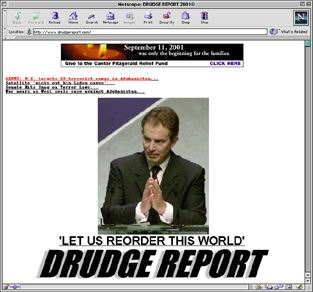
Is this the latest news? Let’s visit www.drudgereport.com.

Clicking brings this news: “Satellite ‘picks out bin Laden caves’…” which links to an up-to-the-minute Times of London article with the details. Reload and… wait, here’s the Washington Times’ headline and link to “U.S. targets 23 terrorist camps in Afghanistan…”

Drudge “will find the link before you do,” says journalist Ken Layne, himself a fast and furious newshound.

It’s not just Layne who has noticed that Drudge is THE clearinghouse for the breaking news. According to the latest figures from Neilson/Netratings, DrudgeReport.com rang up 10,759,000 pages impressions for the week ending September 16.

That puts Drudge’s site ahead of the Washington Post, the New York Times, USA Today… and every US news site except Time Magazine and MSNBC. Click for the top twenty page-spinners.

Drudge inverts conventional web wisdom. Consider the odds against his success :

  1. Drudge’s site is a scoliotic skeleton of text. Haute couture for Drudge is pasting up a single snapshot.
  2. Up against news organizations with 100s of reporters and editors, the site is a one-man show; when Drudge sleeps, the site is static.
  3. When his competition’s traffic is churned out by visits to 100s of current pages and 1000s of archive pages, Drudge’s site is essentially ONE page.
  4. This page is expressly designed to send visitors away. Almost every word is a link to another site!

And this is what makes Drudge great. He knows what the public wants — news — and works tirelessly to deliver it. We can rely on him.

With galaxies of news and opinion available online, Drudge knows it’s better to build a telescope than another solar system.


When will someone log the echoes of September 11 documented in the local press?

Read a Cornwall paper’s obituary of a local boy who left home at 17, became an American, fought in Vietnam and died in the World Trade Center as head of Morgan Stanley’s security team. Or, for a lighter aside, there’s the Lincolnshire man who is selling his nightclub and “planning to fill his new warehouse at Stallingborough with a whole range of military supplies, including armoured cars, military-style hard hats, gas masks, survival suits and camouflage netting – in preparation for war.”

E-mail us if you know of more stories in this vein.

Adding nuances to “back to basics”

October 4, 2001 In the last blog, I argued that September 11 burst the seams of professional news sites & that these sites could learn from the contrasting success of blogs. Here are some other perspectives:

1) Simon Crane, with 15 years experience as a UK journalist and editor, agrees that site design too often exists “to serve the tastes of the designers rather than the users.” But the context and interactive features offered by publication web sites shouldn’t be purged in the rush to blog-like simplicity.

2) Corporate ego, not designers, may be to blame for traditional news sites’ over-engineering and brand-bloat. Photographer Reid Stott writes, “news has become obscured by heavy handed attempts at graphic branding that generate more clutter and confusion with poorly placed content.”

3) Book-design opinionado Dean Allen highlighted the “urgency and directness” of CNN’s September 11 site on his funny and insight-filled blog www.textism.com. “There’s such pure logic in the stripped design.” Don’t miss his link to MSN’s September 11 site and this comment: “You can picture some worthless little editor, sweating bullets, if I pull Elton John will I lose my job?”

4) Blogs are unreliable. Northcliffe’s Keith Perch acknowledges that “we are all guilty of overdesign” and cites his own experience of multiplying a site’s traffic by stripping out whizzy visuals. While agreeing that publishers can learn from blogs, he thinks the blog standard is too low to satisfy the average reader. “The truth is that many (most?) people do want their information edited – that’s what they pay for in newspapers. And they want it to be accurate and reliable.” Perch complains that many blogs “are inconsistent, links are broken, and they can take you inadvertently to places you don’t want to go.”

4) Blogs distill a reality too fragmented for a single organization to comprehend, says San Jose Mercury News’ columnist Dan Gilmore. Readers of weblogs on September 11 were “were witnessing — and in many cases were also part of — journalism’s future.” Bloggers know “that our readers, listeners and viewers collectively know more, vastly more, than we do,” says Dan.

6) The blog, as a diary of events, captures something missed by the computerized information-sorting schema used by most professional news sites. After rereading his own blog of September 11 long-time blogger Dave Winer noted “it’s good to have a record of the events as they happened.”

Let’s amplify this point. It’s GREAT to have a record of events “as they happened”… and great to be able to peruse the strata of one individual’s experience of those events.

The blog’s diary-like stacking of events is easy to take for granted… but this structure may be a key virtue.

Traditional publishers, scrambling daily to make room for cargo-loads of fresh-arriving news, shove their old product into a giant warehouses, from which it can be later extracted only through powerful search algorithms. But brute searching power can’t replicate the natural rhythm of scrolling back through the chronological record.

The blog’s chronological news sorting fits well with innate human story-telling (aka information-processing) habits.