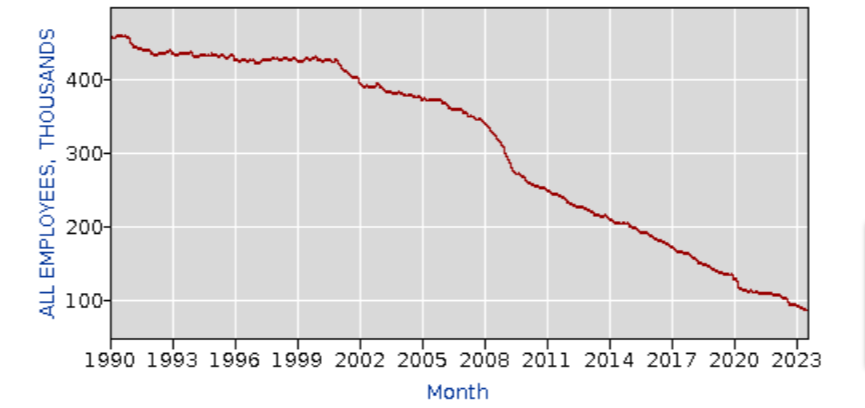
Poor old newspapers are headed into the dust

But was the golden age really that golden?

There’s no doubt that newspapers are dying. Employment at newspaper publishers has declined steadily since the World Wide Web sprouted in the 1990s, and the trend shows no sign of reversing. Pressflex itself was launched in 1998, near the high point of the industry.

It’s not just competition from free, distracting or false information online. Except for the New York Times and Guardian, attempts to migrate content and audiences online have largely failed. And print,  the delivery mechanism that its prime demographic prefers, is being destroyed by the rising expense — Labor shortages, aging equipment and raw materials. “Adam Strunk, managing editor of Kansas’s Harvey County Now, wrote a column in June stating that the costs of printing and mailing that weekly newspaper had soared by 42 percent in the past two years. Each copy cost $3.03 to print and produce while subscribers were paying $1.26, he wrote.” There’s not a single newspaper press in Vermont. 

And there’s no shortage of pundits bemoaning the civic effects of the death of the industry.  “Responsible journalism is the foundation of our collective ability to address our problems as a society: to improve “the common good,” according to Eric Altman.  

“Most areas that lose papers do not get a print or digital replacement, creating news deserts and ‘crisis for our democracy,’ a recent study showed.

At the same time, some journalists with a foot in the golden age recall that there were lots of problems —sexism, racism, commercial biases, boosterism, cronyism, focus on feel-good, pollyanish. Even the technology of newspapers often ruin good journalism. “This is a very frustrating game,” one journalist wrote. “You won’t be given enough time to go over a favorite piece ‘one more time.’ You will have to write with incomplete information. The printers, or layout man, or copy-cutter, or someone, will lose that critical, qualifying, third paragraph.

Parlez vous Google?

How the world’s most popular search engine shapes knowledge

WHILE DOJ lawyers are busily arguing that the search engine behemoth Google suppresses economic competition, few scholars or pundits have paused to consider that Google is reshaping knowledge itself.

Marshall McLuhan’s adage “the medium is the message,” which first appeared in print six decades ago, persuaded us that the physical characteristics of different media – whether TV or books or libraries – each distinctly shape the knowledge they transmit.  

McLuhan argued that books — laborious to research, write and edit and expensive to publish, distribute and store — elevated knowledge that was conscientious, contemplative and aspiring to permanence. Pretending to be “the last word” on its particular topic, each book pretended to build on everything that had gone before in its particularly domain, cultivating an aura of authority and objectivity. In contrast, TV, because it was ephemeral and comprised of flashy images and soundbites, fostered cultural subjectivity, superficiality and flashiness. (You can read my arguments that different media types have profoundly shaped the trajectory of medicine here.)

In recent decades, commentators have made the obvious move of using McLuhan’s paradigm to argue that the Internet itself is yet another reality-shaping medium, and a negative one at that. For example, Nicholas Carr wrote an entire book in 2010 arguing that the Internet is making him dumber, “tinkering with my brain, remapping the neural circuitry, reprogramming the memory.” His metaphors get wilder — “Once I was a scuba diver in the sea of words. Now I zip along the surface like a guy on a Jet Ski.”

Carr cites arguments by Maryanne Wolf, a developmental psychologist at Tufts, that the Internet is altering how we read and how we know. According to Carr, “Wolf worries that the style of reading promoted by the Net, a style that puts ‘efficiency’ and ‘immediacy’ above all else, may be weakening our capacity for the kind of deep reading that emerged when an earlier technology, the printing press, made long and complex works of prose commonplace. When we read online, she says, we tend to become ‘mere decoders of information.’ Our ability to interpret text, to make the rich mental connections that form when we read deeply and without distraction, remains largely disengaged.”

BUT few pundits or professors have argued that Google itself is sufficiently large and uniquely configured that it should itself be understood as a distinct medium, one that shapes the knowledge it captures and transmits. 

Google is big, bigger than most of us can imagine. Not only does Google serve more than 92% of Internet searches, it’s the world’s most frequently used website. Every day, Google sends visitors to well over 100 million different websites.  It’s even graduated to verb status — we “Google” for information.

Google isn’t just another site, it’s a mechanical vehicle that profoundly shapes the information that survives (by being read) and thrives (by being cited) in the 21st century. Google’s unique features and their effects on the shape of knowledge are distinct from those of the Internet.

The bottom line is that if a specific nugget of fact, argument or entertainment is not prominent when someone searches Google for that specific information, the nugget effectively does not exist. For example, the #1 result seen after a Google search gets four times more clicks than result #5. Links that aren’t on page 1 are rarely read.

Making matters worse, Google feeds positive and negative feedback loops. Content that is well placed on Google is read more often, which results in more links into the content from other sites and content, which in turn contributes to an even stronger position in search results.

There are an estimated 1000 factors that go into ranking well on Google and businesses that depend on Google searches for customer try to work many of those angles.

Factors include:

  • Inbound links: the number of links to content were Google’s original algorithm for determining how prominently to display a piece of content. This worked well enough until a) old (well linked) content obliterated newer content with fewers links and b) ecommerce companies started paying people to link to their key content.
  • Headlines that are both direct (answering a searchers question) and intriguing (inspiring a click)
  • Content descriptions that confirm the searcher will be rewarded for clicking the link
  • Content length

Trying to get your content high in Google search — Search Engine Optimization (SEO) — is no longer the province of geeks and webmasters. Authors and editors who aspire to disseminate ideas have to care about SEO arcana — what’s the right number of letters in a meta description tag? What keywords should the author focus on using (and how many times) in an article?

Those concerns become just as much of a job responsibility as writing a headline or a nut graf. The author or editor should ask: What’s a 1-3 phrase that captures the subject of this article? How do we summarize this message in 160 characters or less for our intended target audience? What are the most likely phrases someone would use in searching for my article? Once the right phrase(s) have been identified, what other content is there on the site that we can link to / from relating to this key phrase? What are other sites that might want to link to my article?

Some WordPress plug-ins promise to automate this process, but only the author or editor can grasp the organic goals of the content.

Is this too much work for authors or editors? Unfortunately, we’re in an age in which “speaking in Google’s grammar” is just as important as using correct English or French grammar. If you don’t play the game, your work is ignored.  

Privacy policy

COMMITMENT TO YOUR PRIVACY

This site is owned and operated by Pressflex. Your privacy on the Internet is of the utmost importance to us.We want to make your experience online satisfying and safe.

Because we gather certain types of information about our users, we feel you should fully understand the terms and conditions surrounding the capture and use of that information. This privacy statement discloses what information we gather and how we use it.

Definition of the Information

Pressflex gathers and keeps track of the following information about visitors:

Information Pressflex gathers through aggregated tracking information derived mainly by tallying page views throughout our site. This information allows us to better tailor our content to visitors’ needs. Under no circumstances does Pressflex divulge any information about individual users to third parties.

USAGE TRACKING

Pressflex tracks user traffic patterns on our sites. However, we do not correlate this information with data about individual users. Pressflex does break down overall usage statistics according to a user’s domain name, browser type by reading this information from the browser string (information contained in every user’s browser).

Pressflex will sometimes track and catalogue the search terms that users enter in our Search function, but this tracking is never associated with individual users. We use tracking information to determine which areas of our site users like and don’t like based on traffic to those areas. We do not track what individual users read, but rather how well each page performs overall. This helps us continue to build a better service for you.

COOKIES

We may place a text file called a “cookie” in the browser files of your computer. The cookie itself does not contain personal information. A cookie can’t read data off your hard disk or read cookie files created by other sites. Pressflex uses cookies to track user traffic patterns (as described above).

You can refuse cookies by turning them off in your browser. If you’ve set your browser to warn you before accepting cookies, you will receive the warning message with each cookie. You do not need to have cookies turned on to use this site.

USE OF INFORMATION

Pressflex may use any information voluntarily given by our users to enhance their experience in our network of sites, whether to provide interactive or personalized elements on the sites or to better prepare future content based on the interests of our users.

We use tracking information to determine which areas of our sites users like and don’t like based on traffic to those areas. We do not track what individual users read, but rather how well each page performs overall. This helps us continue to build a better service for you. We track search terms entered in Search function as one of many measures of what interests our users. But we don’t track which terms a particular user enters.

We will not disclose any information about any individual user except to comply with applicable law or valid legal process or to protect the personal safety of our users or the public.

SHARING OF THE INFORMATION

Pressflex uses the above-described information to tailor our content to suit your needs. We will not share information about individual users with any third party, except to comply with applicable law or valid legal process or to protect the personal safety of our users or the public.

SECURITY

Pressflex operates secure data networks protected by industry standard firewall and password protection systems. Our security and privacy policies are reviewed periodically and enhanced as necessary and only authorized individuals have access to the information provided by our customers.

OPT-OUT POLICY

We give users options wherever necessary and practical. Such choices include:

· Opting not to participate in certain interactive areas, which completely alleviates the need to gather any personally identifiable information from our users

YOUR CONSENT

By using this site, you consent to the collection and use of this information by Pressflex . If we decide to change our privacy policy, we will post those changes on this page so that you are always aware of what information we collect, how we use it, and under what circumstances we disclose it.

Connecting the dots on UK press skulduggery

The circle of complicity in the UK phone hacking conspiracy is spiraling outward and upward, with the arrest yesterday of Rupert Murdoch’s protégée Rebekah Brooks and the resignation of Scotland Yard chief Paul Stephenson.

As the New York Times noted yesterday, Scotland Yard has been willfully negligent, if not actively collusive, in its investigation of the hacking into the phones of UK celebrities and crime victims by journalists at News of the World.

So far, the focus has been on NOTW and Murdoch’s hirelings and cronies. But isn’t it now obvious that the conspiracy to cover up the journalistic phone hacking probably goes far wider, implicating many members of the UK press itself?

While the UK press has slumbered, the aggressive reporting about phone hacking has been consistently led by US journalists, for example in the September 2010 investigative blast in the New York Times magazine.

As the Times reported then, “interviews with more than a dozen former reporters and editors at News of the World … described a frantic, sometimes degrading atmosphere in which some reporters openly pursued hacking or other improper tactics to satisfy demanding editors.”

Let’s assume that, at best, hacking was only perpetrated by NOTW journalists. That premise would still make hundreds of members of the UK press complicit in the hacking, since many either have once worked at NOTW and known about the hacking or had friends who worked there.

In an interview (below) before Brooks resigned, a TV journalist asks a spokesman for Newscorp, NOTW’s owner, whether Rebekah Brooks could honestly lead an investigation into actions that had occurred under her own watch as editor of NOTW. The spokesman shudders and stutters, trying to avoid saying the obvious: you can’t investigate yourself. The same logic must be true for many members (and former members) of the UK press itself.

For example…

Tina Brown, editor in chief at Newsweek and The Daily Beast, quipped after the NYT’s expose last September that “I’m shocked, shocked to learn … that the voice mail messages of celebrities have been bugged for tidbits of gossip—can you believe it?—by the Murdoch press in London.” At the time, I’d assumed that Brown’s use of Captain Renault’s iconic “I’m shocked” line from Casablanca was just an playful way of saying she’d strongly suspected there was hacking.

In fact, it’s possible that Brown was giving a self-indicting double wink. That, like Renault, Brown’s knowledge likely wasn’t theoretical or speculative and that within the UK press fraternity, the practice was common knowledge. After all, Brown was formerly the editor of UK magazine Tatler and is married to Sir Harold Evans , former long-time editor of The Sunday Times known for his investigative prowess and one-time Murdoch employee. As a former member of the UK press herself, Brown may have intimate knowledge of the phone hacking habits of her peers. Being friends with some of the miscreants, or friends of friends, Brown is doubtless cautious about throwing too many stones herself.

Again, the best case scenario is that no former NOTW staffers were silly enough to take their phone hacking skills when they changed jobs. At worst, journalists at multiple publications were engaged in the hacking, and the UK presses’ persistent investigative lethargy is not just the product of professional courtesy to fellow club members, but an attempt to avoid wielding a tar brush that might be turned on itself.

The Times says that the practice was widespread in the UK (saying in the 2003 slide of its NOTW timeline that “Former reporters say that hacking into the voice-mail of story targets was a widespread practice at NOTW and elsewhere”) but doesn’t follow-through on the implications of what amounts to a giant conspiracy of silence in the UK.

For now, the UK press is focused on chasing the scandal ever higher inside Newscorp. It’s obviously exciting to ask whether billionaire James Murdoch will be arrested soon too. It’s not just exciting, though. It’s useful. Keeping the spotlight headed upwards helps the UK press avoid asking hard questions of itself.

So it is up to the US press (and UK bloggers?) to ask: who at The Financial Times doing phone hacking? The Independent? The Daily Mail? The Guardian? The Sunday Times? The Telegraph?

(Update: Guardian editor Alan Rusbridger offers a stunning chronicle of his own paper’s attempt to report on NOTW’s misdeeds and the overall ‘omerta‘ in the UK press.)

Connecting the dots shouldn’t be too hard. As social network expert Valdis Krebs notes, network analysis might be one good tool for journalists to use in unraveling this story. By tracking which NOTW reporters moved on to other UK publications, you might find patterns that would trace the infectious spread of hacking practices.

Tools like Influence Networks might help. Or our tool, Twiangulate.

So. Onward into the muck.

(Update: Here is Reuter’s take on NOTW’s ethical vacuum:

New staff would be given the cold shoulder until they’d proved themselves to be “thoroughly disreputable” so their colleagues could trust them. It was no place for anyone to pipe up and say: ‘This doesn’t seem ethical to me.’ That would have made you a laughing stock.”

Journalists didn’t explicitly ask for private investigators to get involved in their work, but help would be provided if a reporter got stuck on a promising story. “How it arrived on your desk was a bit of a mystery. You didn’t know and you didn’t ask,” said the reporter. “Every week, somebody’s mobile phone records, somebody’s landline records, sometimes even somebody’s medical records. It was common enough not to be notable.”

It looks like London mayor Boris Jordan agrees with me:

London’s mayor, Boris Johnson, a former journalist, has a typically contrarian view: “I think we’re going through one of these periodic firestorms of hypocrisy,” he told NEWSWEEK. “I’ve got no doubt that a good number of papers were engaged in identical practices to those of News of the World. The confected outrage about the intrusions that you’re reading in some newspapers that I won’t mention by name, except to say that they’re the Daily Mail—I’d be amazed if these papers weren’t engaged in similar practices. Including the Daily Mirror and maybe others as well.”)

Posted in FAIL, Old media | No Comments »

Read more: http://web.blogads.com/blog/category/old-media/#ixzz8GhTvvAbr

Page size/ load times

Pressflex optimizes site for users of developing and least developing countries. Targeted readers of certain sites hosted by Pressflex are visitors of these areas as well.

Some examples of the implementation:

Dropdown menus are written javascript in order to avoid further downloading when opening submenus.

Pressflex ensures the possibility to display content in “multilevel” and each has the opportunity for the reader to skip the files and only reading the content: eg it is optional to upload images/videos into category front pages within the summary; it is optional to upload them within the full story; it is optional to upload images separately and only downloading them as a separate links.

Classified advertising is on the move

Pressflex researched and coauthored the first ever cross market survey of classified advertising migration to the Internet, published by the World Association of Newspapers.

The pace of the migration from print to Internet is relentless, but manageable. By confidently and imaginatively managing the market, publishers can retain their profits and customer relations as they and their advertising move toward the digital age.

This report offers some simple rules to help newspapers retain their grip on their classified markets.

For more information and to obtain a copy of the report, click here.

What customers are saying

“The OECD Observer magazine has jumped from being invisible to being highly ranked on the world’s main search engines. Pressflex has done what it said it would do when we teamed up in 1999.”

Rory Clarke
Editor, OECD Observer
www.oecdobserver.org
www.observateurocde.org

“We get a surprisingly healthy number of new subscriptions. We were running quickly and with no development costs. Pressflex has deep roots in journalism, and their consultations with our staff have been extremely beneficial.”

Howard Bennett
MD, Special Publications Ltd.
www.scottishfield.co.uk
www.fishupdate.com
www.fishfarmer-magazine.com
www.aquaculturetoday.co.uk

“With our 4 sites we have substantially enlarged our audience. Readers who find us via search engines sign up for our e-mail newsletter and subscribe to the print edition of the magazine. The site has become a new way for generating subscriptions.”

Christiane Senicourt
Publisher, Energie Plus
www.energie-plus.com
www.atee.fr
www.biogaz.atee.info
www.clubc2e.org

“It is a simple and logical task to put up the latest issue each month and to provide other services such as a specialist industry diary and a poll for readers. Pressflex has always been helpful in solving any problems we have and also in providing expertise to help generate traffic for the site.”

Ken Sharpe
Editor, Modern Building Services
www.modbs.co.uk
www.jobs.modbs.co.uk

BLOGONOMICS: MAKING A LIVING FROM BLOGGING

Self-organized networks of bloggers offer advertisers access to previously unarticulated demographics

Martin Nisenholtz claims that the “weblog phenomenon does not represent anything fundamentally new in the news media.” He’s right, of course. We’ve had OpEd pages for more than 100 years, Xeroxed family Christmas newsletters for 50 years, home pages for a decade. A blog, seen on its own, does no more than mix these old ingredients in a new pot. Bloggers have thrashed the likes of Nisenholtz with arguments that blogs are better, faster and cheaper than “old” media. But the point, I think, is that blogs don’t just excel existing media, they are beyond media. Blogs aren’t nu-media but unmedia.

Blogs are not rewired Daily Bugles, they are a ferocious crossbreed of Wal-Mart’s cost-efficiency, distribution, and coordination with the Shakers’ passion, patience and craftsmanship. (Update 2/16/03: the service that grew out of this essay is live at Blogads where you can buy blog advertising or keep abreast of news on nanopublishing, textads, blog ads, thin media and blogonomics.)

Blogs don’t just push the media envelope, they fly out of orbit on new trajectories. Entrepreneurship Blogs will enable millions of new idea entrepreneurs (aka freelance journalists.) Capillarity The networks of these bloggers, the blogosphere, powers knowledge-sharing far more profound than anything offered by current media. Blogonomics The blogosphere is spawning “blogonomics” so bloggers can profit from delivering commercial information to the communities they inform.

1. Entrepreneurship In framing their $1000 bet about whether blogs will overshadow the NYTimes.com by 2007, Dave Winer and Nisenholtz essentially bet on a contest between amateurs and professionals, “people writing… for the love of writing, without any expectation of financial compensation” versus “private parties.” This is a false dichotomy. The blog battle is not just between amateurs and pros, it is also between entrepreneurs and news organizations. Yes, Dave is right that there will be millions of amateurs and that much of what they write will be more compelling and useful than what is written today by “professionals.” But, at the same time, the blogosphere will enable hundreds of thousands of new idea entrepreneurs to carve out local, ideological or conceptual niches and make a living. Bloggers are the ultimate speculators! At least 80% of any media organization’s revenues are spent on “overhead” — the executive parking garages, broadcast towers, helpful distribution unions, wood pulpers and stolid German makers of printing presses as big as the Super Dome. Take these costs out of media and you slash the tax on writing — the number of writing jobs and the amount of quality content will rocket.

2. Capillarity If the soloists outnumber the orchestra, who conducts? James D. Miller argues that a blogging boom will self-destruct. “The proliferation of blogging sites makes it especially difficult for consumers to know which bloggers they would find interesting,” he writes. But Miller’s Malthusian view of blogging focuses exclusively on the blogger’s role in producing words, which is obviously only part of the equation. First, each blogger reads five to 25 other blogs, more than offsetting any word-supply she generates. Second, she evaluates the blogs, recommending a few, ignoring most. So a new blogger is a net contributor of order rather than noise to the blogosphere.

This hand-sorting gets short shrift from many technophiles. But I agree with Bill Quick (coiner of blogosphere) that “word-of-blog” comes naturally. In offline dealings, we regularly evaluate phenomena using word-of-mouth knowledge — judgments passed along by friends and friends of friends and judgments inferred by counter-trading the people we think are idiots. The same strategies work well online. Long before I read Margo Kingston, Tim Blair told me all I need to know. But can word-of-blog cope with the awesome scale of, say, all 500 million Internauts blogging at once? What happens when we have 73 blogs about Wooster, red blogs, prose blogs, gun blogs, ska blogs, braless blogs, blog blogs, bong blogs, 29,471 Boston blogs, when we have three blogs for anyone who thinks for a living or lives for thinking: a blog for work, a blog for play and blog for family? What happens when Laura Bush, Zonker Harris, Bill Gates, Britney Spears, Homer Simpson, John Edwards and Tiger Woods all blog?

Well, if we assume that each blogger reads an average of 15 blogs, and that (since we are not yet clones) each blogger reads five blogs that are not on everyone else’s hit parade, we can bet that no matter how big the blogosphere grows a) there will be plenty of eyeballs to go around and b) we will all be within a few clicks of any pertinent piece of news and c) valuable information should quickly and efficiently percolate to any reader who might want it. Think capillary action, the magic that defies gravity to suck water molecules to the top of a redwood. Sure, opinion pages, online diaries, Christmas newsletters, commonplace books and blogs are old news. What is new is the blogosphere, the endless and (physically) effortless networking of conversations. This is the exponential leap. We’ve had the leaves; now we have the twigs, branches and trees that can connect us all together into a real-time forest of minds. The blogosphere is a social fractal, a network that scales up and down with equal facility. As an information processor, the blogosphere superfluizes old media’s expensive and carefully constructed infrastructures and franchises. Suddenly, Vivendi, AOL-Time Warner, EMAP and Newscorp are factories whose economies of scale are swamped by infinity, networks that have come unplugged, refrigerator salesmen trudging into the next ice age.

3. Blogonomics From the blogosphere grows blogonomics (coined by Matt Welch.) The old economics of media – he who controls distribution wins the most readers and serves advertisers best – will be plowed under by a new economics – she who relates best attracts the most valuable audience. (Since relate means connect and tell.) The metrics do not yet exist to describe the blogosphere’s commercial potential. Anyone who blogs knows we are operating in a new dimension beyond brand or marketing footprint. The newspaper or TV station with 10 viewers has, um, let’s count them, 10 connections. The blogger read by nine other bloggers participates in a network of up to 45 direct human relationships. (I don’t know the formula — draw ten dots in a circle, connect each dot to every other dot, then count the lines.) 1,000 bloggers generate more communication value than 100,000 readers. (Sure, a power law distribution may result, but the possibility of 500 million bloggers boggles traditional media — 10 blogs each may serve 100 million unique users a day, 1000 each will serve 10 million readers a day, 100,000 each will serve 1 million readers a day, 10 million will draw 1000 readers a day and 489,898,990 will serve 100 readers a day.) Blogs serve passionate, activist citizens who eat, drink, drive, argue, influence and buy more voraciously than their couch-potato neighbors. (The blogger’s energy is a cause and effect of blogging, I think.) Blog readers, wired to value peer knowledge over brand, are a prime audience for new messages.

The blogosphere’s self-organized networks offer adventurous advertisers the opportunity to target unique and previously unarticulated demographics. Advertising in a blog or blogset will enable an advertiser quickly to communicate with a critical mass of thinkers. As Virginia Postrel noted recently in the New York Times, “advertising to large markets where audience members are unaware of each other isn’t as valuable” as advertising to people who share “common knowledge” of each other. She outlined goods that benefit from advertising around events or media that serve as “common knowledge generators”:

Some are goods whose value increases as more people adopt them (or, in the case of computers, as more people adopt the same operating system). That’s one reason the famous Super Bowl ad for Macintosh in 1984 was so important. It’s also why the Discover card was introduced with six ads during the 1986 Super Bowl. A credit card is good only if enough retailers accept it, which will happen only if enough consumers use it, which in turn depends on how many retailers accept it — a “network externality” that depends on common knowledge. Other products, like cars, sneakers or soft drinks, use ads to create brand associations, adding symbolic characteristics to their products. Those characteristics may be valuable if only the buyer knows about them, but they’re worth more if they’re widely understood.

In the long run, the blogosphere seems like the perfect “common knowledge generator” — a dream advertising medium for innovative companies.

3.1 But who will advertise? I agree with Reid Stott’s view that traditional advertising agencies won’t quickly learn how or why to advertise on blogs. They’ll keep flogging the horse they rode in on. In any case, while a few big companies may have the vision to sponsor bloggers or blog communities, I’m afraid that most ad agencies and corporate advertisers will not understand the blog’s unique power. Clayton Christensen wrote in his amazing 1997 book Innovator’s Dilemma that “rational managers can rarely build a cogent case for entering small, poorly defined low-end markets that offer only lower profitability.” It is a safe bet that blogs will serve “small, poorly defined low-end markets” for some time to come, and that advertisers just won’t know what to do with them. The good news is that we don’t need ads from name brands like GE or Enron, and probably don’t want them — business history says that most of today’s biggest companies will be dust in 50 years and that some of today’s motes are tomorrow’s supernovas.

In the beginning, blog advertising will likely be P2P. Ken Layne could sell Dot.con. Glenn Reynolds could sell baseball hats. Tony Pierce could point to his E-Bayed molars, or whatever other teeth he loses. Amy Langfield may promote the 9/11 book. Matt Drudge could sell autographed photos or Tshirts. Many Blogads may be traded gratis among friends. It will be a long haul. Slowly, critical mass will build. New ad classifications will emerge. New demographics will cohere. Companies will be invented to fill new niches. 3.2 Will advertising bust the blogs? Matt Haughey, who has done great things for blogging and textads at metafilter, thinks commercialization is inevitable. But he worries that blogging will be tainted by:

writing entries to please your readers and advertisers, not yourself, posting entries because you have to, to get paid, lazy fact-checking to push things in under deadlines, conflicts of interest, and lack of disclosure of who is paying you and why…

Yes, some bloggers may not to display ads. No problem. But ads can help, I think. First, markets do a better-than-average job (over the last 5000 years, at least) of allocating resources, rewarding good work and punishing the slipshod. Bloggers are idea entrepreneurs, living in a clickocracy, risking their time and passion on writing. Bloggers who inspire large or passionate audiences can be rewarded for this by advertisers. There are, beyond money, other benefits to creating a blog advertising idiom. Establishing a clear space and format for advertising will clarify what is flogging and what is blogging. No more need to plug for your friend’s book between paragraphs about Arafat. Second, blog readers may be pleased to have a chance to buy goods and services from companies or individuals who appreciate blogs, who support their beliefs, who value their values. Ads are themselves interesting and useful content. I will be fascinated to read who or what advertises on Mr. Layne’s site.

3.3 Our contribution: Next month, Pressflex will begin public testing of Blogads, a service to help individual bloggers sell and display classified ads. Each blogger will set his own prices and approve his own ads. Each ad may include graphics and can link to outside sites or to a larger ad. We will host the service and take a small fee on each ad sale. Classifieds play an important role in communicating commercial information within communities and happen to be the source of most newspapers’ profit margin. But, in the early years, our service will likely not serve the mainstream classified niches – cars, real-estate and jobs – because each blogger’s audience is too widely dispersed. A reader of James Lileks’ site may love his blog, but she probably won’t advertise her house there. But she may want to offer legal services, sell a book or announce an E-bay auction of Weezer tickets. James himself may want to promote his favorite businesses. (Who does not already talk up their favorite restaurant, barber or digital camera, hoping that the vendor’s quality will be rewarded and reinforced?) Eventually, a sufficient density of local blogs could make Blogads an effective tool for selling local goods and services. Some publishers (I know of one already) may embrace Blogads and decide to use the service to network with local bloggers and democratize their markets. They are welcome to join us. Likewise, we look forward to collaborating with blog technology peers to grow blogging’s crumb-in-a-slice of the media pie into its own wedding cake.

HTTPads is a great idea, if you like banners. Textads need classification and more flexibility for both buyer and seller. (Although omitted in the first edition of this article, I admire Blogsnob’s name, elegant simplicity and network-boosting power.) Pyrads is a strong offering, but seems to be in hibernation since Blogger’s growth accelerated. Userland, MovableType, Pitas, Greymatter – we are eager to talk. In recent weeks blogger friends from Los Angeles to Budapest have made suggestions. Their ideas have been very helpful. Five bloggers have volunteered as beta testers. We would appreciate help from a couple more passionate, tech-adept bloggers. Anyone who is particularly passionate about this idea should write henry@pressflex.com. Or if you would like to hear when Blogads goes mainstream, sign up here.

To move this thing forward, we’ll have to tweak and evolve and scramble. It will take us a year to get 95% of the way, another two years to go the next 4% and another decade to go the final 1%. Our company, which provides web sites to print publishers, is profitable and can sustain a long slog. (In fact, we won’t mind a slog, since it will scare off the VC-fueled fast-buck artists.) To close, I will wager $1000 that on May 25, 2007 there will be more Blogads than NYTimes.com classified ads or that NYTimes.com will be using Blogads. Ready to bet, Martin? (Yes, the winnings will go to the Blog Foundation.) Update: see for the latest Blog advertising news and visit to order Blog classified ads.)

Henry (Hank) Copeland in Budapest, Hungary

Wild, Wild EAST

April, 1992 Matt and I are on our way to Ivana Trump’s ball at Prague’s opera house. Our tickets say “black tie or tails,” so Matt has washed his shoulder-length blond hair, shaved, and put in a conservative earring. He’s wearing a rented set of tails with sleeves that reach his thumbnails and a pair of white wing-tips shoes that belong on a putting green. I’ve spent all day acquiring the last rentable pieces of clothing in Prague that look like a tux: a blue suit that is tight in the crotch, along with a black vest and six-by-three-inch tie, circa ’73.

Matt Welch, twenty-four, is covering Ivana’s ball for prognosis, an English-language newspaper he helped start a year earlier in Prague. There have been rumors of an anarchist “action” planned for the evening.

We are walking up Wenceslas Square, the cobblestone venue for many of the demonstrations that toppled Czechoslovakia’s Communist regime at the end of 1989. Everyone we pass stares, first at Matt’s shoes, then at my bow tie. “Dressed like this probably a good invitation to getting the shit kicked out of us,” Matt says. He is silent for a while and seems to be calculating the Norman Mailer points he’ll earn for a brawl… in a foreign country… in tails.

A crowd has gathered at the top of the square, and man in a trench coat has climbed up on the statue of King Wenceslas himself and is shouting something. Tails flapping, Matt strides into the crowd, looking for someone who speaks English, and soon finds Jiri, a second-year agronomy student in a black leather jacket. Jiri interprets for us: “The rich people at the ball think they are the kings and queens of today.” Someone jeers, and Jiri repeats in English, “Words, words, only words.” Jiri’s friend keeps eyeing our bow ties and muttering. The crowd is ugly and impatient for action.

Our anarchist explains, “This ball is a provocation for poor people-the ticket costs 17,000 crowns. For 15,000 crowns I can study one year.”

Another anarchist climbs onto the statue and shouts something that translates as, “This speaking is over, now everyone by himself can walk anywhere.” That, as it turns out, is an anarchist’s way of saying, “Let’s all go to the opera.” Jiri grins and pulls a bandanna over his face. The mob of 150 sets off, whistling, jeering, dragging sacks. Matt and I follow.

ON NOVEMBER 7, 1990, SIX AMERICANS WHO had been friends at the University of California, Santa Barbara met in a bar in Prague to exchange stories about their summer travels in Europe. Matt had moved to Prague two months earlier to write The Novel, Christopher Scheer and Jennifer Ogar had just arrived to teach English, and Laura Pitter, Ben Sullivan, and Lisa Frankenberg were passing through on their way to Italy. All these plans were quickly forgotten.

They had all worked on the UCSB paper, the Daily Nexus, and by the end of that night, the six, along with some Czech students they were drinking with, had decided to start an English-language newspaper in Prague.

Ten thousand copies of prognosis appeared the first week of March 1991. That first issue was sixteen pages long, a monthly put out by a staff that had grown little from the original circle of drinkers. By the time the paper went biweekly in the fall of 1991, it was twenty-four pages long, and the staff had grown to nearly forty.

Prague now is often compared with Paris in the ’20s. Hemingway was twenty-three when he first met Gertrude Stein, and Prague is crowded with Americans that age or a little older. Like the wine-stained cradle of Hemingway and Fitzgerald, Prague is cheap, drunken, and crammed with culture and people who don’t bathe every day. In fact, the city is more beautiful than Paris, one of the few cities in Europe where you can find five hundred years of architecture untouched by either shrapnel or stainless steel.

The Wild West or its variations – boomtown, Dodge City, the last frontier (before Russia), the new gold rush – are another easy take on Prague. But the fact is that the Czech and Slovak Federal Republic does resemble the Wild West. There are huge holes in the law’s fences and plenty of unclaimed territory. The CSFR is full of hustlers who plan on getting rich, whether by rustling a herd of tourists or by hiring Czech coolies for $100 a month or by staking a claim on a field lawmakers haven’t yet fenced off. Evidence of the hustle is everywhere.

The day of the ball, I started my search for a tux at Kotva, Prague’s main department store. Last summer I had gone to Kotva to buy an umbrella and found a store that looked like it was in the final hours of a remnant sale. Now Kotva is exploding. Where before Kotva offered only three models of umbrellas, now there are twenty-five, including a Michael Jackson version unfurled above the cash register. There is a Levi’s boutique, a Barbie boutique, boutiques selling flowers, cosmetics, pens, and gourmet food. A paraglider hangs in the sports department. Shoppers collide and spin and hustle on to buy more. It’s like Macy’s before Christmas. In the old days. But no tuxes.

I left the store and immediately passed several billboards advertising Harvard Capital & Consulting, a fund-management company set up in a country that does not yet even have a stock market. More Prague hustle. In the last two months, Harvard Capital has acquired control of 5 percent of the coupons for the privatization of the CSFR. It has done this by guaranteeing citizens a tenfold return on their investment. Harvard Capital is run by a guy who got his B.A. from Harvard University in 1989 and then, it is said, worked for a bank in London for a couple of years. He assures his backers, “We have formulas.”

In Prague these days, many people have formulas. The city is the magnet of the moment for assorted and sordid drunks, Samsonite-toting carpetbaggers, snake-oil salesmen, hangers-on, recession refugees, moths to the torch of history, and other seekers of fortunes and Fortune. They are filling up Prague’s fifteen-dollar-a-month apartments and packing its bars, which serve beer for a quarter. Everyone agrees that Something is Happening here; prognosis is near the center of it.

Sitting in prognosis‘s big messy office just off Prague’s Old Town Square, twenty-three-year-old Jeff Solomon puts it this way: “Where else are you going to get this kind of opportunity? Like, it’s impossible to get a job right now in the States in journalism, and if you did you’d be covering your local school board.” His mane of hair and drooping hand-rolled cigarette bob as he gestures. “I’m going to interview a count this afternoon about a new Czech royalist parry. I’m doing a story about the influence of the Velvet Underground and getting to talk to a lot of the great Czech band members. The magnitude of the stories blows your mind.” Jeff handles the paper’s staffing, and he says he has forty-five letters to answer from people in the United States wanting to come work for prognosis.

THE OFFICE, THOUGH, IS NOT NECESSARILY the place to search for the truth about Prague or prognosis. I go to a club called RC Bunkr, a newly opened concrete basement with a black ceiling, a paint-smeared floor, and psychedelic walls. Nirvana buzzes around black clothes, black hair, and white faces with high cheekbones. The Bunkr was created by a bunch of Czech artists and students, part of a complex they have opened that includes a cafe, a radio station, and a recording studio.

“That’s Kip. Don’t try to interview him, he’ll bite you,” Matt says. I’ve been looking for Kip since I got to Prague. He is the city’s Dean Moriarty, described as lunatic, brilliant, inspiring, intoxicating, exasperating, or just blitzed. Kip writes for prognosis, Kip is generally acclaimed King of Intoxication in Prague, and Kip was one of the first UCSB alumni to try to get to Prague.

The first time Kip tried to move there, he had lost all his money before leaving and spent his last night in L.A. raising cash from friends in bars, five dollars here, ten dollars there, until he had sixty bucks. Clutching this he had flown to Europe, only to return nine days later with stories of hitchhiking in the driving rain to within fifteen miles of the Czech border. Kip made it on his second try, and after he left L.A., friends composed a song, “Gonna Miss Ya Kip,” the last line of which is “when you’re dead.”

You smell Kip before you see him, his cigar-burning-in-a-jockstrap odor turning your head. He looks like Ichabod Crane on mushrooms, tall and bony, his hooknose framed by squinting eyes that are in turn framed by greasy, chin-length hair. “Five phone callss to Germany, that’ss all it takess, Matt,” he says, grinning and hissing, his body dancing with his words. “I’ve got an opinion piece for your fine paper, my friend Matt, that I will trade for five phone callss to Germany.” He repeats this several times, his long, bony hands waving like they’re beckoning a rabbit out of a hat.

We drink a few whiskeys. I’m realizing that I unknowingly experienced Kip on my last visit to Prague. It was one of those late, hash-hazed parties in an artist’s attic way up six dark flights of stairs, furnished with a few mattresses shoved against the walls and lit by a spotlight someone was waving around. Two guys were sitting on the floor banging on guitars and caressing feedback out of the dial of an amp. Fifteen feet above them, perched at the top of a ladder, a voice was unwinding a two-hour rap about Prague, Armageddon, the Garden of Eden, money, motherhood, and flowers. That was Kip. But Kip stumbles off before I can get him to talk about Prague or prognosis. Later, I learn that he has been thrown out of the Bunkr for biting someone.

I TAKE A CAB UP THE HILL TO THE CASTLE (capitalized like the White House) overlooking Prague. The Castle is a majestic fortress, but it is also the lair of the mythical Havel. I’m going to meet John Allison, a former New Yorker, an “almost thirty-two”-year-old ex-magazine editor who works in the office of the president and writes columns for prognosis. John has been here since September of 1990, and people say he knows every American in Prague. John meets me at the reception desk, and I spend the five-minute walk to his office trying to reconcile John’s bookish manner with a photograph on the wall at prognosis depicting John with a three-foot fish hanging out of his mouth.

The office looks out over St. Vitus, a spectacular cathedral, and down into the courtyard where Havel passes daily. John opens a bottle of wine. Explaining his move to Prague, he says, “I wanted to be where something new is happening, where something is growing. In New York, everything was falling apart, everything was crisis management.” John gestures to the card file on his desk that holds the names of Americans and Czechs he knows here, most of them young, most of them in politics, academia, and business. He intones, “I’m out every night meeting people.” Has he met Havel? “I watched him take a leak at a New Year’s Eve party.”

Then John gets to the roots of his attraction to Prague. He says he heard Havel’s speech to the U.S. Congress in February of 1990 and thought, “My God, this is what politics should be, this is what public discourse should be, this is my calling.” John’s voice has risen majestically, and now he pauses, looks out the window, and smiles. “Also Prague is a great party town.” Aha. We drink a liter of wine while we talk.

The visit with John highlighted three of Prague’s attractions: architecture, proximity to History (even if that only means taking a leak beside Havel), and alcohol. Alcohol. As John says, Prague is a great parry town. The Czechs have the best beers in the world, beers that are twice as strong as most anything in the United States. Pilsner Urquell and Budvar for thirty-five cents a bottle.

ON NOVEMBER 7, 1990, THE NIGHT THE SIX from California got together and conceived prognosis, alcohol, of course, was involved. “There was,” as Matt wrote later, “a lot of drinking, a lot of talking and dreaming, a lot of brainstorming. We’d be weekly, we’d sell shares, we’d hit up rich liberal types, we’d be damn good, we’d be a place for Nexus grads and entry-level burnouts. We’d at least have a great time trying.” Remarkably, the paper didn’t evaporate the next morning.

Back in America, word of the new paper spread like a fire up a dry hillside. Calls and letters poured in, saying not just that people were interested, but that they were coming. Wade Daniels, a Nexus editor who had graduated in ’89, wrote a letter to Matt on November 29 that began, “Yes, Yes, Yes,” and continued, “I would really be stoked to come hang out and do what I can for the magazine. What I need is details, directions. How does one find you in Chekoslovankea?” He is now managing editor.

Amy Collins, who was still in college, heard about the plans for the paper sometime that November from friends at the Nexus. The night before Thanksgiving break, she made her decision to move to Prague. She had drunk six cups of coffee while working on a term paper, gotten into bed after midnight, and been unable to sleep. She was thinking about Prague. Amy says, “About five hours later, I had somehow come up with this whole idea, not only that I was going to go, but I had gotten down to what I was going to pack. It was simple. It wasn’t anything I was going to shout about, it was just like, “Why wouldn’t I go? . Why hadn’t it occurred to me earlier that I should go?”

That winter, apartments were hard to find. Everyone first moved into the apartment Matt was sharing with two Czechs. The two Czechs slept in one room and the six Americans slept in the other room along with two or three stray visitors who crawled in most nights. Matt wrote later, “We’d have eleven or so smelly people, at least four of whom were coupled off, living in a small smelly place, running the cold water with the bathtub plugged and then bailing out into the kitchen sink.” (The bathtub drain leaked into the apartment below.) There wasn’t much food in the stores. Dinners were often potatoes and onions, with an occasional pot of spaghetti or canned tuna for variety. Tea, lemon vodka, and beer washed it all down.

“It was much worse in our next apartment,” says Christopher Scheer, twenty-four, who survived the winter to become the paper’s editor-in-chief. The heater, which also was the source of all hot water, was broken for two months. They wore coats, hats, and gloves around the apartment, even blankets. The stories from that winter sound too miserable, too crazy to be true, like Valley Forge on acid. There were the mice. At Christmas, Christopher bought Jennifer three mice named Vaclav, Olga, and Faust that grew into foot-long rats and chewed their way out of every cage to forage in the frozen mess.

The rats ate a set of accounting books, and soon everything else was equally surreal. These Americans knew little about what it took to start a business, especially in a foreign country. Information was garbled by interpreters, but everyone in Prague was having problems. There was chaos, like after an earthquake. Old laws had fallen and nothing put in their place. The group spent the briefly lit winter days trying to find a printer, an office, a distributor, a lawyer. They met with a lot of Czechs who, as Christopher phrases it, “had dreams themselves that were bigger than they could pull off.” Which is to say they promised things they didn’t deliver.

A lot of time was spent just looking for a lawyer, one who had a phone, who didn’t disappear after three weeks of work, who didn’t want to own half the paper for his trouble, who didn’t say “nemozne” (it isn’t possible). There were many weeks when nothing got accomplished, when each person would leave the apartment every morning and chase shadows through Prague’s narrow streets all day, returning empty-handed. Money was dwindling. The group began to wonder, in Christopher’s words, “Is this thing real, is this thing happening, are we shitting ourselves?”

Finally, at the end of January, things started to click. The group rented a tiny office for $300 a month. Two days later, a competent lawyer showed up. In a six-week push, prognosis secured licenses from the Ministry of Culture, the Ministry of Finance, and the Ministry of Statistics, passing out bottles of gin to whomever looked thirsty. But the paper was still two licenses short. According to Laura Pitter, twenty-five years old and now news editor, “By this time we were desperate to publish. We had all this energy pent up from months of thinking about the thing.” Rather than wait, they borrowed another paper’s printing license and sidestepped the lack of a distribution license by passing the first issue out free on the streets.

On March 7, 10,000 copies of Zero Issue rolled off the presses. Given its hellish gestation, the paper was surprisingly healthy. Ben wrote an article on Prague’s new drug problems, Jennifer wrote an overview of the expanding Czech press, Matt went looking for “underground” culture, Laura examined the government’s privatization of small businesses, and Christopher wrote about a Czech woman who had started her own paper in a small mining town.

Soon, people started to show up from the States looking to pitch in. Mark Mirko, a wild-eyed photographer for The Palm Beach Post, heard about the paper and called to ask for a job. Ben Sullivan, the twenty-four-year-old publisher, told him, “Sure, come on over, bring $200 and we’ll take care of the rest.” Mark recalls, “When I got here and saw the office and the issues, I couldn’t understand how the two went together. We were in this tiny room in an old barn. there was shit all over the floor, and a dozen people trying to put out a paper with no space to work in.”

The staff got down to reporting. Ben and Mark went to Yugoslavia soon after the first shots were fired to report back that full-scale war was imminent. Ben wrote a letter to be mailed if he didn’t return: “Dear Family, Well folks, guess I died. I’m sorry it was so stupid of me to go (ask prognosis folks for details) but I wanted to and, in a weird way, had to, journalistically.” Jennifer interviewed a woman who had set up outrageously profitable sex shops all over the country. Wade interviewed, and finished a bottle of vodka with, the head of the Czech Communist parry. A Czech staffer, Denisa Schüková, went undercover to expose a scheme to lure unsuspecting women to Switzerland to work as strippers. Kip participated in and reported on a thirty-four-hour event/train ride/binge organized to honor Andy Warhol.

It turned out that they underestimated their readership. In addition to the armies of young Americans and other foreigners passing through, there were those who stayed to teach English. Most importantly, there were also the young Czechs. Three thousand copies of prognosis are distributed free every two weeks to Czech and Slovak schools for use in English classes. A teacher I talked to said five classes read the twenty five copies of the paper he gets. He says, “They are completely silent for the first twenty minutes after I hand it out. The American perspective on things seems to have a special appeal to them.”

The Americans, in turn, find something in Prague that they can’t find at home. “In Prague, everything is so open that you can reinvent yourself every day,” says Brenon Daly. He’s been up all night writing. Through the window comes the sound of coal being dumped, wheelbarrow-by-wheelbarrow, down a chute into the basement. Brenon graduated from the University of Kansas in May 1991, and came to Prague in August. “The grim economic scene was propelling me out,” he says, “but there was also the sense that there was just a morass of people in the States not knowing what they wanted to do, and really just uncertain and inactive. Prague is different. People have so many visions because everything here is up for grabs.”

8:45 P.M. THE MOB, WHISTLING AND JEERING, positions itself across the avenue from the opera house. A ballgoer arrives in a polished Mercedes and is greeted with a roar and a barrage of rotten peaches. The crowd chants in Czech and sometimes in English, “Fuck you,” and “No future.” Matt catches up with Jiri, who explains that they are throwing peaches because “eggs are very expensive.” A chef in his tall white hat walks out onto the balcony of the opera, provoking another roar and peach fusillade. The pace of the arriving cabs is picking up, and the rain of peaches and jeers develops a kind of tempo, a rhythm that is itself accelerating. Someone tosses an M-80 under a passing car. Every time a peach scores, smearing a fur coat or catching a policeman in the face, the mob’s engine revs.

9:00 P.M. An anarchist steps on my foot and says, “Excuse me.” Or so I hope. An anarchist is offering Matt something to throw, but he politely declines. One half of the mob surges across the four lanes of traffic, and now vastly outnumbers the police who are guarding arriving ball-goers. A white stretch limo with New York plates slows down in front of the opera house and then, as the crowd rushes to it, speeds away. The anarchists now surround both the front and side entrances to the opera hall. Policemen are shuttling people through the throng, shielding arrivals with their bodies. The police try to drag away a hooded protester, and the crowd chants, “Ge-sta-po, Ge-sta-po, Ge-sta-po,” punching each syllable out. The most vehement anarchists swarm from entrance to entrance, pursuing each flashy car, kicking the doors, spitting on the windows. A pack of twenty photographers dashes behind them, its flashes mingling with the dark-coated roar like a summer lightning storm. One anarchist stands clapping mockingly in front of a trapped black BMW full of ball-goers. A cloud of tear gas lets loose. A muzzled police dog arrives, a big black pit bull that lunges at the crowd.

9:45 P.M. The riot is not abating, but neither side is using new tactics. The night has reached a strange equilibrium, like an arm wrestling match when equal opponents have become exhausted, arms still balanced upright. I’m freezing, and I haven’t seen Matt for half an hour. Maybe he’s inside. Bravely waiting until the mob’s attention is focused on the front entrance, I walk slowly up the stairs to the side door. I pretend to peer in, but at the same time I’m trying to signal the guards inside with my bow tie. They open the door, and I slip inside. The gilded entrance hall is packed with silk dresses and bow ties, wrinkled flesh and champagne glasses. A smirking white coat decked with medals strides by.

1:00 A.M. I’ve found Matt. Neither of us has gotten close to Ivana for an interview. The anarchists have gone home, and we are left to wander through the opera house’s four tiers looking for empty tables where we can sit and drink from abandoned champagne glasses. At 4:30 A.M. I head to bed, but Matt sticks it out, just in case something happens. After all, the decade is still young.

© Henry Copeland 1992-2002

This article appeared in the April 1992 issue of Details magazine.
Click to read more about
prognosis alumni Matt Welch, Ben Sullivan, John Allison, Chris Scheer, Amy Collins, Ken Layne and Os Tyler.
More
prognosis alumni links welcome.