Content sales and protection

Pressflex enables publishers to sell content or restrict content access to print subscribers.

Our search engine optimized architecture ensures you still get the thousands of referrals you deserve each month; then our tease-and-trap design helps convert these visitors into customers.

All payments are handled by specialist services like

so you and your customers know you are getting the best security.

Delo

“DELO, Slovenia’s leading daily, invited Miklos Gaspar as a web publishing adviser to the Internet Development Strategy workshop in March 2003. Miklos revealed to us all the possiblities of our site we did not recognize before. He shared his knowledge on how to achieve a successful web presence with minimal investment. We found his lectures and report very effective and useful, and we are looking foward to working with him again.”

Zoran Trojar
Marketing Director
www.delo.si


Winning the Google battle for visitors and Adsense

Ignoring Google is costing you money and readers. We can help you solve both problems today. Excelling in a shot-gun list of search engines is not cost-efficient. Google currently admits to processing 6 billion querries a month — the real number is probably much higher — and may account for up to 80% of all searches. Pressflex can benchmark your site versus its peers on four key Google metrics. If your site falls short — probably by 50-95% — we’ll recommend some simple steps to radically improve your performance in Google. Performing well in Google is particularly important with the launch of the Google Adsense programs, which places context-relevant ads onto a publisher’s sites. Publishers ranging from the Washington Post to USA Today are using Adsense. In various online forums, publishers report effective CPMs of anything from $3 to $6, or, as one publisher put it, “seven times what my banner network is bringing.” Adsense makes a strong contribution to your bottom line, with no cannibalization. Google places ads for over 100,000 150,000 advertisers around the world, and there is little chance that your ad reps are talking to these advertisers right now.
You are missing readers and advertising revenue. Get on the right track. Contact us.

World Business Council for Sustainable Development

“Pressflex proved to be great support in launching WBCSD‘s online newsletter, Sustain online, and with Pressflex’s assistance and knowledge, Sustain online managed to win almost 2000 e-subscribers in less than a year. Moreover, Pressflex’s excellent judgment and advise and their technology were essential in our outreach work during the 2002 World Summit in Johannesburg.

We subsequently retained Pressflex to consult with us on usability issues during the launch of our organization’s new web site. Pressflex’s mix of editorial, publishing, marketing and technical skills was exactly what we needed in fine-tuning the presentation and organization of our massive amount of content. It has been a pleasure to work with them!”

Thorsten Arndt
Online Communications Manager
World Business Council for Sustainable Development
Geneva, Switzerland

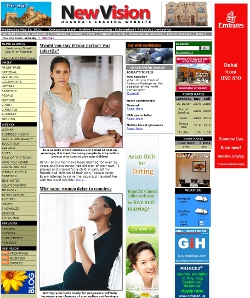
The New Vision

“In February 2003, Miklos Gaspar of Pressflex came to Uganda to do an Internet health check for the New Vision, Uganda’s leading daily newspaper. Our successful site already attracts a large amount of traffic but Miklos came up with a series of excellent suggestions for increasing traffic, rationalising the structure of the site, and increasing commercial revenue to the point of breakeven. We have used various experts with general Internet skills before but we found it exceptionally useful to employ a consultant whose specific expertise is in newspaper Internet sites. I am sure we will work with Miklos and Pressflex again in the future.”


William Pike
Managing Director/Editor-in-chief
www.newvision.co.ug
www.orumuri.co.ug
www.rupiny.co.ug
www.etop.co.ug


It’s Google, stupid.

Sept. 24, 2002
Googles debut of its news portal has competitors like CNN.com and Yahoo.com quaking.

The service scrapes headlines from 4000 news sites every 15 minutes, sorts and presents.

In considering implications for publishers, most analysts have focused on the “front page” where news is aggregated according to preselected topics like “business,” “sports,” and “entertainment.”
http://www.mediainfo.com/editorandpublisher/features_columns/article_display.jsp?vnu_content_id=1712373

While the portal threatens, it also presents significant opportunities and for niche publishers. Unfortunately, there are a few threats too.

Google has 15,000 servers. Do you want to work with them or against?
Threats:
a) Higher value for “alternative” sources.
b) CMS gets downplayed.

Opportunities:
a) Niches get deeper.
b) Major gains for those who understand how to use news as teaser for their businesses.
c) News addiction rises.
d) Huge free marketing.
e) Every page is home page.

C) Bad URLs cost. Trinity Mirror, the UK’s biggest publisher, still has only a tiny fraction of its content in Google: http://www.google.com/search?hl=en&lr=&ie=UTF-8&oe=UTF-8&q=+site:icbirmingham.icnetwork.co.uk+icbirmingham
Daily newspaper with only 1820 pages in Google. Weekly courrier de Mantes has 8000.

First, we need to understand how big Google is.

Consider New York City, where Google thrashes the paper of record on its own front stoop.

The New York Times portrays itself as The City’s Leading Information Source. And as one discovers by crunching NYTimes.com’s own audience figures, the paper gets an average of 1.2 million visitors a day or roughly 11 million total users in a month.

But these numbers pale when we consider that Google serves 12,195,400 searches a month for the words “New York.” And 68,400 for “World Trade Center.” And 91,200 for “Bloomberg.” And 144,400 for “NYSE.” And 630,700 for “Broadway.” And 752,300 for “Manhattan.” And 22,800 for “Pataki.” And 60,800 for “Empire State Building.”

You get the idea. Here’s the scary thing; the number of Google searches for “New York” has grown 62% since March. When was the last time the New York Times grew its web audience by more than 20% a year? (All Google figures gleaned from its old Adwords program.)

Here are some other Google search tallies for publishers to chew on. Google gets 11,260,800 searches a month for “London.” “Atlanta” gets 2,302,300 a month. “Los Angeles” gets 3,442,100 a month.

Now, Google goes for the news jugular. Google has been running an alpha version of its news scraper for months, putting relevant headlines atop search results. This week, its “news.google” page began serving up whole pages of relevant news scraped from 4,000 sources.

Noting that the NYTimes URLs in News.Google include the word “partner,” Dave Winer suggests some special benefit will accrue to the paper. I don’t know what he’s thinking. Will Google skew its news judgement to send some extra visitors to the Times? My bet is that the partnership simply (and only) jumps visitors past the Times’ registration module.

In fact, News.Google shames the NYTimes.com. On the ten articles highlighted on the current news aggregation for “New York,” only two are from the New York Times. Only one of ten for the “New York City” search is from the Times.

Assuming Google’s content relevance and peer weighting algorithms continue to run the show, News.Google will boost well-networked bloggers as Google’s source of highly referenced sites expands. The key thing to watch — when and how will Google expand the list of 4,000 news providers.

Kuro5hin and Slashdot are already included. (But no Metafilter?) Will Blogcritics or Instapundit or Scripting News be next? Will Drudge, the human headline squeegee, ever make the list?

The bottom of Google’s new news aggregator says: “This page was generated entirely by computer algorithms without human editors. No humans were harmed or even used in the creation of this page.”

No humans harmed… but more than a few corporations will drown as the river of news floods and erases its old banks.

Want the latest news and views about News.Google? Where better to check than the source itself.

(9/26/02 Nick Denton, former CEO of headline aggregating Moreover.com, examines a Google fumble in presenting news. And Leslie Walker writes: “the former editor in me feels humbled at how a computer is able to assemble on the fly an adequate version of what it takes a dozen or two humans to do at most major Web news sites.”)

If you are in the news business, forget how you manage and serve information. Don’t bother going to fancy content management summits. Instead, spend some time thinking about how readers acquire information.

Eager to test-drive the next content management system? Open a web-browser. Type www.google.com. Voila.

Serving over 5 billion searches a month, Google is by far the world’s biggest single information server, the global content management system. For premium, information-hungry readers, Google is, defacto, both the homepage and prefered acquisition tool for most important information.