Blogging from 1750 to 2302

March 5, 2002 Many thanks to science fiction editor Patrick Nielsen Hayden for calling my recent enumeration of winning blog traits “the best of the many overviews of the Blog Phenom we’ve all been reading lately.”

Patrick underscores chronological presentation in the blog’s appeal:

human beings are wired for Story the way we’re wired to read tiny shifts of facial muscles, and the most compelling bloggers aren’t necessarily those with the most insightful analyses or even the best links (although both skills help!); the most successful are those who get the reader invested in their own ongoing story.

Speaking of stories, I saw this nugget in Robert Darnton’s Euro essay in the February 28 issue of the New York Review of Books (unfortunately, the article is not free online):

After its creation in Constantinople in 1560, the coffeehouse proliferated in all European cities from the mid-seventeenth century. It first appeared in London in 1660. By 1663, London had 82 coffee houses, by 1734, 551. Because of their free talk and virtuosi, they became known as “tattling universities.” They also served as centers for political cabals, for they provided pamphlets and newspapers as well as drink. The first London daily began in 1702 — long after the first daily newspaper in Germany (Leipzig, 1660) but long before the first in France (Paris, 1777). Print, talk and coffee combined to create a powerful new force everywhere in Europe: public opinion, and public opinion took a radical turn in all the great cities.

Hearing that drip, drip, drip of happy words: coffee, free talk, virtuosi, tattling, university, print, talk, coffee, public opinion, public opinion… I couldn’t help but think of the Internet, particularly the blog.

Of course, we’ve heard plenty of arguments that the “web culture” is both cause and effect of a “post-intellectual” society characterized by “rootlessness, mobility, a sense of impermanence, a loss of orientation.” We are, critics like Donald Wood wail,

entangled in a confusing snarl of conflicting relationships, ephemeral links, impermanent ties, cyber-networks, social ambiguities, information anarchy, temporary jobs, technological domination, and diffused responsibilities.

And we’ve heard enough about the Internet’s effects on business to accept that, at least if you are Sun Microsystems or the small B&B in Edinburgh that earns 80% of its revenues because of the Internet, the Internet is a business revolution.

But is this where we stop, or where we begin? Just as coffee-houses and newspapers underwrote modern democracy, today’s new communications tools and spaces will create new thoughts, new dialogs, new relationships, new tempos, new philosophies… new societies.

Psychiatrist Eliot Gelwan said in a 2000 interview that blogging “really reinvigorated my reading the news. I think about things in a different way.” What happens when one billion people “think about things in a different way?” In 2302, perhaps this will be the story that 10@robidart.com (Robert Darnton the tenth) writes:

After its creation in Settle in 1971, the Star$ proliferated in all hubs from the early 21cent. It first appeared in LondE in 1998. By 2005, LondE had 82 Star$, by 2083, 15,451. Because of their e-talk and virtuosi, they became known as “tattling universes.” They also served as centers for political cabals, for they provided blogs and metafilters as well as drink. The first LondE blog began in 1997 — not long after the first blog in Swizz (CRN, 1990) but long before the first on Mune (Narmstrong, 2075). Coming after decades of Teevee enervation, blogs and caffi combined to create a powerful new force everywire: Public Epinion, and Public Epinion took a moderate turn in all hubs…

*****

Here’s evidence that a) blogging predates press-powered journalism and b) the first blogger was an eighteenth century Parisienne’s servant.

You should read the whole of Darnton’s March, 2000 lecture on the nascent media’s role in the French Revolution. First, here’s the key excerpt :

But ordinary hearsay did not satisfy Parisians with a powerful appetite for information. They needed to sift through the public noise in order to discover what was really happening. Sometimes, they pooled their information and criticized it collectively by meeting in groups such as the famous salon of Mme. M.-A. L. Doublet, known as “the parish.” Twenty-nine “parishioners,” many of them well connected with the Parlement of Paris or the court and all of them famished for news, gathered once a week in Mme. Doublet’s apartment in the Enclos des Filles Saint-Thomas. When they entered the salon, they reportedly found two large registers on a desk near the door. One contained news reputed to be reliable, the other, gossip. Together, they constituted the menu for the day’s discussion, which was prepared by one of Mme. Doublet’s servants, who may qualify as the first “reporter” in the history of France. We don’t know his name, but a description of him survives in the files of the police…: He was “tall and fat, a full face, round wig, and a brown outfit. Every morning he goes from house to house asking, in the name of his mistress, ‘What’s new?'” The servant wrote the first entries for each day’s news on the registers; the “parishioners” read through them, adding whatever other information they had gathered; and, after a general vetting, the reports were copied and sent to select friends of Mme. Doublet. One of them, J.-G. Bosc du Bouchet, comtesse d’Argental, had a lackey named Gillet, who organized another copying service. When he began to make money by selling the copies—provincial subscribers gladly paid six livres a month to keep up with the latest news from Paris—some of his copyists set up shops of their own; and those shops spawned other shops, so that by 1750 multiple editions of Mme. Doublet’s newsletter were flying around Paris and the provinces. The copying operations—an efficient means of diffusion long after Gutenberg and long before Xerox—had turned into a minor industry, a news service providing subscribers with manuscript gazettes, or nouvelles à la main.

Henry Copeland from Paris, France
Big media beats the blog drum

February 25, 2002 The traditional press (known in some circles as “old media”) is jumping on the blogger story, writing about and drafting bloggers. The time seems ripe to recap the coverage and to describe what makes the blog so threatening to media incumbents: timeliness, willingness to credit others, passion, blogrolling, human interest, chronology, and devotion.

Blogging, the practice of writing an online diary and news round up, has been touted as a potential competitor for mainstream press for a long time (including this blog on September 20 and October 5), but the tempo of the blog beat is rising.

On September 20, 2001 master linkster Nick Denton wrote in the The Guardian that post-September 11 weblogs were “uncovering a wealth of information, a variety of opinion, and a subtlety of judgment.” He concluded that “in weblogs, the web has become a mature medium.” On January 9, 2002 polymath blogger Glenn Reynolds warned that traditional media should “beware the people who are having fun competing with you!” in “A Technological Reformation.“

On January 17, blogs became important enough to be pilloried for self-congratulation and earnestness by former Suck.com funster Tim Cavanaugh in “Let slip the blogs of war.” On February 18, the Weekly Standard contributed a parody called “Blog ad nauseum,” suggesting that “those who don’t have a life are forced to invent one.” (Via www.NickDenton.org)

On February 5, PC Magazine offered a cynical list of factors driving people to write blogs: antidepersonalization, elimination of frustration, societal need to share, wanna-be writers.) In short, bloggers are vain.

Wired News offered a good and link-filled blogging review on February 18, which lead with the observation that “there’s perhaps no better proof that an idea has gained the attention of the mainstream than a mention on National Public Radio,” as had occured 5 days earlier.

On February 23, Canada’s National Post admitted that blogger Matt Drudge may be “responsible for a huge chunk of WashingtonPost.com’s traffic” but concluded “it’s doubtful that personal blogs will supplant newspapers anytime soon.” On February 24, The Times of London offered pundit-turned-blogger Andrew Sullivan’s take that bloggers threaten conventional media because they can “read the next day’s op-ed columns online the night before and get in pre-emptive rhetorical strikes before readers had even tackled the next day’s papers.” Most recently, on February 25, The New York Times served up a lukewarm answer to the question posed in its headline “Is Weblog Technology Here to Stay or Just Another Fad?”

Surveying this rash of articles, Meg Hourihan, co-founder of blog-tool Blogger, wrote yesterday that attempts to paint blogging as “just another Internet fad” ignore blogging’s viral vigor:

Previous Internet fads, which had all the longevity of a firecracker (the expectant hush, a boom and burst of light, and then nothing), included Portals, Vortals, Push, B2B, B2C, and the whole “dot-com” thing. But those fads emerged in a top-down fashion–they were created by marketers and analysts making big pronouncements because they had something to offer or gain by doing so. The weblog hype, for the most part, has come from the bottom up, from the people actually doing the weblogging.

As Hourihan notes, media incumbents aren’t just writing about blogs — “500,000 and rising fast!” — they are trying them on.

Publishers are stepping into the now-dust-filled footsteps of the Wall Street Journal‘s opinion page web section called “Best of the Web” which began in July of 2000. On February 12, the old-style new-media Salon incorporated a blog. On February 19, Fox News announced it was bringing “some of the web’s newest voices under its wing with the addition of the Fox Weblog.” Fox drafted martini-smooth Ken Layne to post a weekly weblog and enlisted other luminaries to join a rotation.

PC World assumed blogs aren’t read by anyone but their authors. (“People can’t resist updating the diary and apologize if they don’t do it—as if anyone really cares.”) But as I noted before, ur-blogger Matt Drudge’s single ugly web page often attracts more visits than traditional media web sites built and stocked by hundreds of staff. And anecdotal evidence suggests that some casual blogs get more traffic then web sites produced by decent-sized publishers.

So the more important question may be: what makes blogs so interesting to read — and such a potent threat to traditional media? Here are the qualities I would stress:

a) Timeliness and willingness to credit others. These two qualities go hand in hand. Because they are willing to post a link to the original news source, bloggers often convey the news hours before established outlets can commit resources to their own rehash and news top. (Note the domino effect of print-journalists “doing” blogger.) While traditional media avoid reporting anything “not invented here,” bloggers reveal (and revel in) the web’s vast resources through compulsive linking.

b) Passion. Written in the first person singular, blogs can convey a double-barrelled blast of the blogger’s emotions. This emotional richness — irony, elation, bitterness, tears, laughter, profanity, boredom, compulsiveness — has been bred out of corporate-funded journalism. In contrast, blogs feel like human expressions rather than corporate excretions.

c) Blogrolling. By regularly commending and linking to other blogger’s posts, bloggers weave new broadcast networks. (If you don’t own a network, invent your own!)

d) Human interest. Although newspapers sometimes peddle personal tidbits, these are more casing than sausage. In contrast, blogs often provide details from the writer’s life: missed flights, break-ups, rodents under the stove, computer meltdowns, muggings, tamale recipes.

e) Chronology. The blog’s diary-like stacking of events is easy to take for granted but may be a key virtue. Traditional publishers, scrambling daily to make room for cargo-loads of fresh-arriving news, shove their old product into fathomless database warehouses, from which it can be later extracted only with search equipment. I think the blog’s chronological news presentation fits better with innate human story-telling (aka information-processing) habits.

f) Devotion. Because bloggers get to write about what we care about — at whatever length and in whatever detail — we write with far more commitment than the average corporate scribe. Readers are equally devoted.

“We have entered an era vibrating with the din of small voices,” Drudge said in his 1998 speech to a sneering assembly of National Press Club members. As usual, Drudge was first with the story.

****

(For a technology-oriented history of blogs, visit Rebecca Blood’s history. Don’t miss Dave Winer’s first entry for a glimpse of what one of the web’s seminal tech bloggers posted on April 1, 1997. Don’t miss Jim Romesenko’s www.obscurestore.com. This thriving daily compendium of weird stories from newspaper web sites started in January 1998, foreshadowing much of today’s high-quality blogging done by moonlighting journalists. Finally, John Hiler’s blog is an excellent daily resource focused on micro-publishing strategies like blogging.)

Henry Copeland from Budapest, Hungary

Cannibalization? Au contraire!

February 8, 2002

Overview
 
The world’s first countrywide survey shows that local newspapers with websites have healthier print circulations than papers without sites.
 
While conventional wisdom suggests that newspaper web sites cannibalize print circulation, the analysis of circulation at 236 French newspapers shows no such effect. In fact, the typical French newspaper with a web site outperformed its siteless peers between 1999 and 2001, a period in which French Internet usage soared.
 
The French figures validate previous US newspaper readership surveys that have suggested that newspaper web sites generate significant marketing benefits. The market-wide analysis means that publishers with weak circulation can cross the Internet off their list of suspected culprits.
Download this file in .pdf version

Table of Contents 
 
Overview
Summary numbers
Analysis: how does a web site help print circulation?
Daily newspaper circulation performance 1999-2001
Weekly newspaper circulation performance 1999-2001
Context: French Internet usage
Conventional wisdom
Online features and circulation
Methodology
Conclusion
About Pressflex
 
Summary numbers
 
The 236 newspapers, all members of the French circulation audit association Diffusion Contrôle (www.ojd.com) recently released their circulation results for the first half of 2001.
 
Between 1999 and 2001, the average French regional daily newspaper without a web site lost 0.88% of its circulation. Newspapers with web sites did better than that, losing just 0.27% of their circulation over the same period.
 
The average weekly newspapers in France with a web site increased its circulation by 1.2% in the 1999-2001 period, versus an increase of 0.96% for the average weekly without a web site.
 
 
Table 1: Average newspaper circulation changes (=median) 


1999-2001 1999-2001
Daily with site -0,27% Weekly with site 1,20%
Daily without site -0,88% Weekly without site 0,96%


Analysis: how does a web site help print circulation?
 
1. Web sites provide substantial marketing benefits that overwhelm any print defections.
 
A newspaper’s web site, filled with content, can become a magnet for new visitors, effectively doubling the paper’s reach. A fully indexed web site of a small newspaper with a circulation of 10,000 copies can bring the paper an additional 10,000 web visitors a month. Traffic sources include:


  • Search engines: A weekly with only 10,000 in print circulation can win 3,500 referrals from search engines each month.
  •  
     

  • Links from other sites: Links to articles on a news site can provide free marketing, with small weeklies gaining up to 1,000 such visitors a month.
  •  
     

  • Web address publicity: A newspaper’s web address (www.papername.com) is easily promoted on billboards, bumper stickers, posters, and provides an easy point of access for newcomers to the community.
  •  
     

  • Scoops: Beating competitors with online summaries of breaking news items can boost the brand name of a weekly paper and increase its exposure.
  •  


As a magnet for new prospective readers, the site can become a new point of sale for the newspaper’s current subscriptions, special publications and prior issues. The significance of this revenue stream is expected to increase as micropayment technology becomes mainstream, Internet users become more comfortable making online payments, and the euro makes cross-border shopping more popular in Europe.
 
However, much still remains to be done to extract the full marketing potential of web sites, even in the U.S. An August 2001 study by the Finberg-Gentry, Digital Fruit Consultancy found that more than half of 100 American newspaper web sites surveyed bury the subscription link on their sites if they have it at all.1
 
2. The web taps potential readers untouched by traditional print sales channels.


  • Demographics: The typical web reader in Europe is still young, urban and tech savvy – and as such is currently less likely to read the printed edition of the newspaper. This “alternative” audience is not attached to the newspaper, but finds articles via search engines when looking for news on a particular topic.
  •  
     

  • Geography: A substantial flow of readers comes from outside the printed paper’s traditional circulation area – from another part of the country or from abroad.2
  •  


3. News consumption is habit-forming.
 
A newspaper site’s contribution to its community’s “news culture” increases the likelihood that people will buy a paper. A web site with forums, questionnaires, polls or even just an e-mail address can connect with the reader in new ways. Interactivity brings feedback, story ideas, letters to the editor, and local “buzz,” but also a higher level of engagement and loyalty from print readers. A U.S. survey3 last year of 15,657 visitors to eight newspaper-affiliated Web sites found that:


  • Among site visitors who read the print edition, 7 percent began their subscriptions after first visiting the site. That’s a net gain of 3 percentage points when compared to the 4 percent of combined print-online readers who ended their print subscriptions.
  •  
     

  • Single copy purchases faired even better, showing a net gain of 8 percentage points. Readership, rather than circulation, was the biggest winner, with a net of one in five in the combined print-online audience reporting that they were reading the print edition more since becoming visitors to the Web site.
  •  


4. Readers prefer paper to pixels
 
For most readers, the online experience is sufficiently different from print reading that web browsing is not a “replacement” for reading newsprint but rather a supplement. According to a 2000 study by the Newspaper Association of America, print newspapers are preferred over online for their ease of use.4
 
Daily newspaper circulation performance 1999-2001
 
Conventional wisdom notwithstanding, France’s 27 regional daily newspapers with web sites did better in the past two years than their 30 peers without web sites.
 
Regional daily newspapers without sites on average5 lost 1.5% of their circulation over the past two years. Newspapers with web sites did better than that, losing just 0.77% of their circulation between 1999 and 2001.
 
Considering how the “average newspaper” fared, by calculating the statistical median of the data, yields similar results. (Medians eliminate the effect of extreme cases and thus better reflect what happened to a typical group member.) Last year, for instance, the circulation of the average daily paper with a site grew 0.25% versus 0.14% for the average daily paper without a site.
 
 
Table 2: Daily newspaper circulation changes 


1999-2000 2000-2001 1999-2001
Average Median Average Median Average Median
Dailies with site -0.87% -0.28% 0.20% 0.25% -0.77% -0.27%
Dailies without site -1.56% -1.12% -0.14% 0.14% -1.50% -0.88%
All papers -1.18% -0.65% 0.02% 0.19% -1.15% -0.68%


Weekly newspaper circulation performance 1999-2001
 
Of France’s 179 audited weekly papers, just 19 have web sites. Weekly newspapers with sites increased their circulation less than their peers without web sites over the past two years – an average increase of 0.81% versus 1.34% since 1999, but increased their circulation more than their siteless peers between 2000 and 2001: 1.12% versus 1.01%. The average newspaper with a site, in terms of the median, outperformed its counterpart without a web site in both periods: growing 1.20% in circulation versus 0.96% for papers with no sites over the last two years.
 
 
Table 3: Weekly newspaper circulation changes 


1999-2000 2000-2001 1999-2001
Average Median Average Median Average Median
Weeklies with site -0.18% 0.01% 1.08% 1.12% 0.81% 1.20%
Weeklies without site 0.06% 0.05% 0.99% 1.01% 1.34% 0.96%
All weeklies 0.04% 0.05% 1.00% 1.02% 1.24% 1.01%


Context: French Internet usage
 
Although French Internet usage significantly lagged countries like the UK and Germany in the 1990s because of high telephone rates and low PC usage, French Internet usage accelerated in 2000 and has continued to rise. According to market research firm Netvalue, the number of people in France with home Internet access rose from 5.8 million in July 2000 (10% of population) to 10 million (16%) by September 2001. (Comparable Netvalue statistics for the UK are 16% and 26%.)6
 
Conventional wisdom
 
Many publishers instinctively see a web site as a competitor to the print edition. Why would readers pay for news if they can get if for free?
 
Internet research firms have stoked these fears: a 1997 study by Forrester Research projected that by 2001 newspapers would lose up to 14% of their circulation to the web.7
 
And when PCM Utigevers, the largest Dutch newspaper group, drastically cut its online operations in September 2001, it blamed the sites of its five national broadsheets for cannibalizing print subscriptions.8
 
Online features and circulation
 
Do particular web site features help or hurt print circulation?
 
The number of articles included on the site, searchable archives, polls, forums or e-mail newsletters on the web site does not show any correlation to changes in print circulation. The only feature with a possible impact on circulation growth is a print subscription form online.
 
Eight of the 19 regional dailies with web sites included a print subscription form on their sites. These papers did slightly better than papers with no sites or papers with web sites but no subscription form. The eight dailies saw their circulation over the last two years drop by just 0.09% on average, versus an industry average of a 0.96% decline. Weeklies with a subscription feature on their site increased circulation by 1.36% over the same period – more than papers without sites or papers with sites but no online subscription form.
 
Unfortunately for newspaper publishers, the data also indicate that for newspapers the web is not yet as important a marketing tool as for magazines – where web sites strongly contribute to print sales.9
 
Methodology
 
The 57 French daily and 179 weekly newspapers, all members of the French circulation audit association Diffusion Contrôle, recently published their circulation results for the first half of 2001.10
 
After calculating the circulation changes for each newspaper between 1999 and 2000 and between 2000 and 2001, Pressflex compared the performance of papers with sites to those without sites. To evaluate the effect of various online features on circulation, Pressflex also correlated the performance of sites relative to the amount of content online and features such as a poll, a forum, an e-mail newsletter and a print subscription form.
 
For the purposes of this analysis, the Sunday editions and/or various zoned editions of a daily newspaper were not counted. Also, when Diffusion Contrôle tracked the total circulation of a group as well as the circulation of the group’s individual titles, only the circulation of the members was taken into consideration. Newspapers whose web site consisted of only a single page with contact information were counted as papers without sites.
 
Conclusion
 
Online publishing poses no threat to a newspaper’s print circulation and may offer significant advantages. As common sense suggests, the inclusion of a print subscription feature online further boosts circulation performance… although too few paper’s take advantage of this obvious idea.
 
About Pressflex
 
Pressflex provides turnkey sites, consulting and seminars to Europe’s largest publishing groups. Based in Budapest, Hungary, Pressflex serves clients in the UK, France, Switzerland, Hungary and the United States.


1http://www.naa.org/TheDigitalEdge/DigArtPage.cfm?AID=1915
2While this latter trend is the most significant for English language papers, French newspapers using Pressflex’s web publishing service receive to 25% to 40% of their traffic from outside the country.
3Report by Borrell & Associates based on data from research firm Belden Associates and underwritten in part by the Newspaper Association of America. http://www.naa.org/TheDigitalEdge/DigArtPage.cfm?AID=2599
4http://www.digitaledge.org/monthly/2000_01/synergize.html
5To exclude anomalous data, the top and bottom 5% of newspapers have been left out in calculating the statistical mean (average) of newspaper circulation changes. Since the statistical median already excludes extreme cases by returning the middle value from among a set of numbers, the complete data set was used for median calculations.
6http://www.netvalue.com/fr/news/index_frame.htm?fichier=sommaire.htm
7http://www.nytimes.com/library/cyber/week/010697newspapers.html
8http://www.siliconvalley.com/docs/news/tech/060825.htm
9http://www.pressflex.com/news/fullstory.php/aid/18.html
10http://www.ojd.com/gb/basegb/body_resSousCat.asp?cat=1&catChoisi=QUOTIDIENS


For further information about this report as well as other research activities of Pressflex, please contact salesATpressflex.com or Miklos Gaspar at +36 1 328 0602.
 
Return to Top
Cette enquête en français

frcircstudy


Cannibalization? Au contraire!


Overview.. 3

Summary numbers. 3

Analysis: how does a web site help print circulation?. 3

Daily newspaper circulation performance 1999-2001. 5

Weekly newspaper circulation performance 1999-2001. 6

Context: French Internet usage. 6

Conventional wisdom.. 6

Online features and circulation. 6

Methodology. 7

Conclusion. 7

About Pressflex. 7


Overview


The world’s
first countrywide survey shows that local newspapers with websites have healthier
print circulations than papers without sites.


While
conventional wisdom suggests that newspaper web sites cannibalize print
circulation, the analysis of circulation at 236 French newspapers shows no such
effect. In fact, the typical French newspaper with a web site outperformed its
siteless peers between 1999 and 2001, a period in which French Internet usage
soared. 


The French
figures validate previous US newspaper readership surveys that have suggested
that newspaper web sites generate significant marketing benefits. The
market-wide analysis means that publishers with weak circulation can cross the
Internet off their list of suspected culprits.

Summary numbers


The 236
newspapers, all members of the French circulation audit association Diffusion
Contrôle (www.ojd.com ) recently released
their circulation results for the first half of 2001.


Between
1999 and 2001, the average French regional daily newspaper without a web site
lost 0.88% of its circulation. Newspapers with web sites did better than that,
losing just 0.27% of their circulation over the same period. 


The average
weekly newspapers in France with a web site increased its circulation by 1.2%
in the 1999-2001 period, versus an increase of 0.96% for the average weekly
without a web site.


Table 1: Average newspaper
circulation changes (=median)


1999-2001

Dailies
with sites

-0,27%

Dailies
without sites

-0,88%

Weeklies
with sites

1,20%

Weeklies
without sites

0,96%


Analysis: how does a web site help print
circulation?


1.    
The
web taps potential readers untouched by traditional print sales channels.


·   
Demographics:
The typical web reader in Europe is still young, urban and tech savvy – and as
such is currently less likely to read the printed edition of the newspaper.
This “alternative” audience is not attached to the newspaper, but finds
articles via search engines when looking for news on a particular topic.


·   
Geography:
A substantial flow of readers comes from outside the printed paper’s traditional
circulation area – from another part of the country or from abroad. While this
latter trend is the most significant for English language papers, French
newspapers using Pressflex’s web publishing service receive to 25% to 40% of
their traffic from outside the country.


2.    
Web
sites provide substantial marketing benefits that overwhelm any print
defections.


A newspaper’s web site, filled with content,
can become a magnet for new visitors, effectively doubling the paper’s reach. A
fully indexed web site of a small newspaper with a circulation of 10,000 copies
can bring the paper an additional 10,000 web visitors a month.  Traffic sources include:


Ø    
Search
engines
: A weekly
with only 10,000 in print circulation can win 3,500 referrals from search
engines each month.


Ø    
Links
from other sites
:  Links to articles on a news site can provide
free marketing, with small weeklies gaining up to 1,000 such visitors a month.


Ø    
Web
address publicity
:
A newspaper’s web address (www.papername.com) is easily promoted on billboards,
bumper stickers, posters, and provides an easy point of access for newcomers to
the community.


Ø    
Scoops: Beating competitors with online
summaries of breaking news items can boost the brand name of a weekly paper and
increase its exposure.


As a magnet for new prospective readers, the
site can become a new point of sale for the newspaper’s current subscriptions,
special publications and prior issues. 
The significance of this revenue stream is expected to increase as
micropayment technology becomes mainstream, Internet users become more
comfortable making online payments, and 
the euro makes cross-border shopping more popular in Europe.


However, much still remains to be done to
extract the full marketing potential of web sites, even in the U.S. An August
2001 study by the Finberg-Gentry, Digital Fruit Consultancy found that more
than half of 100 American newspaper web sites surveyed bury the subscription
link on their sites if they have it at all. [1]


3.    
News consumption is habit-forming.


A newspaper site’s contribution to its community’s
“news culture” increases the likelihood that people will buy a paper. A web site with forums,
questionnaires, polls or even just an e-mail address can connect with the
reader in new ways. Interactivity brings feedback, story ideas, letters to the
editor, and local “buzz,” but also a higher level of engagement and loyalty
from print readers.
A U.S. survey[2]
last year of 15,657 visitors to eight newspaper-affiliated Web sites found
that:

·       Among
site visitors who read the print edition, 7 percent began their subscriptions
after first visiting the site. That’s a net gain of 3 percentage points when
compared to the 4 percent of combined print-online readers who ended their
print subscriptions. 

·       Single
copy purchases faired even better, showing a net gain of 8 percentage points.
Readership, rather than circulation, was the biggest winner, with a net of one
in five in the combined print-online audience reporting that they were reading
the print edition more since becoming visitors to the Web site.


4. Readers prefer paper to
pixels


For
most readers, the online experience is sufficiently different from print
reading that web browsing is not a “replacement” for reading newsprint but
rather a supplement. According to a 2000 study by the Newspaper Association of
America, print newspapers are preferred over online for their ease of use.[3]


Daily newspaper circulation performance
1999-2001


Conventional
wisdom notwithstanding, France’s 27 regional daily newspapers with web sites
did better in the past two years than their 30 peers without web sites.


Regional
daily newspapers without sites on average[4]
lost 1.5% of their circulation over the past two years. Newspapers with web
sites did better than that, losing just 0.77% of their circulation between 1999
and 2001. 


Considering
how the “average newspaper” fared, by calculating the statistical median of the
data, yields similar results. (Medians eliminate the effect of extreme cases
and thus better reflect what happened to a typical group member.) Last year,
for instance, the circulation of the average daily paper with a site grew 0.25%
versus 0.14% for the average daily paper without a site.


Table 2: Daily newspaper circulation
changes


1999-2000


2000-2001


1999-2001


Average

Median

Average

Median

Average

Median

Dailies
with site

-0.87%

-0.28%

0.20%

0.25%

-0.77%

-0.27%

Dailies
without site

-1.56%

-1.12%

-0.14%

0.14%

-1.50%

-0.88%

All
papers

-1.18%

-0.65%

0.02%

0.19%

-1.15%

-0.68%


Weekly newspaper circulation performance
1999-2001


Of France’s
179 audited weekly papers, just 19 have web sites. Weekly newspapers with sites
increased their circulation less than their peers without web sites over the
past two years – an average increase of 0.81% versus 1.34% since 1999, but
increased their circulation more than their siteless peers between 2000 and
2001: 1.12% versus 1.01%. The average newspaper with a site, in terms of the
median, outperformed its counterpart without a web site in both periods:
growing 1.20% in circulation versus 0.96% for papers with no sites over the
last two years.


Table 3: Weekly newspaper
circulation changes


1999-2000


2000-2001


1999-2001


Average

Median

Average

Median

Average

Median

Weeklies
with sites

-0.18%

0.01%

1.08%

1.12%

0.81%

1.20%

Weeklies
without site

0.06%

0.05%

0.99%

1.01%

1.34%

0.96%

All
weeklies

0.04%

0.05%

1.00%

1.02%

1.24%

1.01%


Context: French Internet usage


Although
French Internet usage significantly lagged countries like the UK and Germany in
the 1990s because of high telephone rates and low PC usage, French Internet
usage accelerated in 2000 and has continued to rise. According to market
research firm Netvalue, the number of people in France with home Internet
access rose from 5.8 million in July 2000 (10% of population) to 10 million
(16%) by September 2001. (Comparable Netvalue statistics for the UK are 16% and
26%.) [5]


Conventional wisdom


Many
publishers instinctively see a web site as a competitor to the print edition.
Why would readers pay for news if they can get if for free? 


Internet
research firms have stoked these fears: a 1997 study by Forrester Research
projected that by 2001 newspapers would lose up to 14% of their circulation to
the web.[6]


And when
PCM Utigevers, the largest Dutch newspaper group, drastically cut its online
operations in September 2001, it blamed the sites of its five national
broadsheets for cannibalizing print subscriptions.[7]

Online features and circulation


Do
particular web site features help or hurt print circulation?


The number
of articles included on the site, searchable archives, polls, forums or e-mail
newsletters on the web site does not show any correlation to changes in print
circulation. The only feature with a possible impact on circulation growth is a
print subscription form online. 


Eight of
the 19 regional dailies with web sites included a print subscription form on
their sites. These papers did slightly better than papers with no sites or
papers with web sites but no subscription form. The eight dailies saw their
circulation over the last two years drop by just 0.09% on average, versus an
industry average of a 0.96% decline. Weeklies with a subscription feature on
their site increased circulation by 1.36% over the same period – more than
papers without sites or papers with sites but no online subscription form.


Unfortunately
for newspaper publishers, the data also indicate that for newspapers the web is
not yet as important a marketing tool as for magazines – where web sites
strongly contribute to print sales.[8]


Methodology


The 57
French daily and 179 weekly newspapers, all members of the French circulation
audit association Diffusion Contrôle, recently published their circulation
results for the first half of 2001.[9]


After
calculating the circulation changes for each newspaper between 1999 and 2000
and between 2000 and 2001, Pressflex compared the performance of papers with
sites to those without sites. To evaluate the effect of various online features
on circulation, Pressflex also correlated the performance of sites relative to
the amount of content online and features such as a poll, a forum, an e-mail
newsletter and a print subscription form.


For the
purposes of this analysis, the Sunday editions and/or various zoned editions of
a daily newspaper were not counted. 
Also, when Diffusion Contrôle tracked the total circulation of a group
as well as the circulation of the group’s individual titles, only the
circulation of the members was taken into consideration. Newspapers whose web
site consisted of only a single page with contact information were counted as
papers without sites.

Conclusion


Online publishing poses no threat to a newspaper’s print circulation and
may offer significant advantages.  As
common sense suggests, the inclusion of a print subscription feature online further
boosts circulation performance… although too few paper’s take advantage of this
obvious idea.

About Pressflex

Pressflex provides turnkey
sites, consulting and seminars to Europe’s largest publishing groups. Based in
Budapest, Hungary, Pressflex serves clients in the UK, France, Switzerland,
Hungary and the United States.

For
further information about this report as well as other research activities of
Pressflex, please contact consulting@pressflex.com
or Miklos Gaspar at
+36 1 328 0602.


[2] Report by Borrell &
Associates
based on data from research firm Belden
Associates
and underwritten in part by the Newspaper Association of
America.  http://www.naa.org/TheDigitalEdge/DigArtPage.cfm?AID=2599

[4] To exclude
anomalous data, the top and bottom 5% of newspapers have been left out in
calculating the statistical mean (average) of newspaper circulation changes.
Since the statistical median already excludes extreme cases by returning the
middle value from among a set of numbers, the complete data set was used for
median calculations.

Wild, Wild EAST

April, 1992 Matt and I are on our way to Ivana Trump’s ball at Prague’s opera house. Our tickets say “black tie or tails,” so Matt has washed his shoulder-length blond hair, shaved, and put in a conservative earring. He’s wearing a rented set of tails with sleeves that reach his thumbnails and a pair of white wing-tips shoes that belong on a putting green. I’ve spent all day acquiring the last rentable pieces of clothing in Prague that look like a tux: a blue suit that is tight in the crotch, along with a black vest and six-by-three-inch tie, circa ’73.

Matt Welch, twenty-four, is covering Ivana’s ball for prognosis, an English-language newspaper he helped start a year earlier in Prague. There have been rumors of an anarchist “action” planned for the evening.

We are walking up Wenceslas Square, the cobblestone venue for many of the demonstrations that toppled Czechoslovakia’s Communist regime at the end of 1989. Everyone we pass stares, first at Matt’s shoes, then at my bow tie. “Dressed like this probably a good invitation to getting the shit kicked out of us,” Matt says. He is silent for a while and seems to be calculating the Norman Mailer points he’ll earn for a brawl… in a foreign country… in tails.

A crowd has gathered at the top of the square, and man in a trench coat has climbed up on the statue of King Wenceslas himself and is shouting something. Tails flapping, Matt strides into the crowd, looking for someone who speaks English, and soon finds Jiri, a second-year agronomy student in a black leather jacket. Jiri interprets for us: “The rich people at the ball think they are the kings and queens of today.” Someone jeers, and Jiri repeats in English, “Words, words, only words.” Jiri’s friend keeps eyeing our bow ties and muttering. The crowd is ugly and impatient for action.

Our anarchist explains, “This ball is a provocation for poor people-the ticket costs 17,000 crowns. For 15,000 crowns I can study one year.”

Another anarchist climbs onto the statue and shouts something that translates as, “This speaking is over, now everyone by himself can walk anywhere.” That, as it turns out, is an anarchist’s way of saying, “Let’s all go to the opera.” Jiri grins and pulls a bandanna over his face. The mob of 150 sets off, whistling, jeering, dragging sacks. Matt and I follow.

ON NOVEMBER 7, 1990, SIX AMERICANS WHO had been friends at the University of California, Santa Barbara met in a bar in Prague to exchange stories about their summer travels in Europe. Matt had moved to Prague two months earlier to write The Novel, Christopher Scheer and Jennifer Ogar had just arrived to teach English, and Laura Pitter, Ben Sullivan, and Lisa Frankenberg were passing through on their way to Italy. All these plans were quickly forgotten.

They had all worked on the UCSB paper, the Daily Nexus, and by the end of that night, the six, along with some Czech students they were drinking with, had decided to start an English-language newspaper in Prague.

Ten thousand copies of prognosis appeared the first week of March 1991. That first issue was sixteen pages long, a monthly put out by a staff that had grown little from the original circle of drinkers. By the time the paper went biweekly in the fall of 1991, it was twenty-four pages long, and the staff had grown to nearly forty.

Prague now is often compared with Paris in the ’20s. Hemingway was twenty-three when he first met Gertrude Stein, and Prague is crowded with Americans that age or a little older. Like the wine-stained cradle of Hemingway and Fitzgerald, Prague is cheap, drunken, and crammed with culture and people who don’t bathe every day. In fact, the city is more beautiful than Paris, one of the few cities in Europe where you can find five hundred years of architecture untouched by either shrapnel or stainless steel.

The Wild West or its variations – boomtown, Dodge City, the last frontier (before Russia), the new gold rush – are another easy take on Prague. But the fact is that the Czech and Slovak Federal Republic does resemble the Wild West. There are huge holes in the law’s fences and plenty of unclaimed territory. The CSFR is full of hustlers who plan on getting rich, whether by rustling a herd of tourists or by hiring Czech coolies for $100 a month or by staking a claim on a field lawmakers haven’t yet fenced off. Evidence of the hustle is everywhere.

The day of the ball, I started my search for a tux at Kotva, Prague’s main department store. Last summer I had gone to Kotva to buy an umbrella and found a store that looked like it was in the final hours of a remnant sale. Now Kotva is exploding. Where before Kotva offered only three models of umbrellas, now there are twenty-five, including a Michael Jackson version unfurled above the cash register. There is a Levi’s boutique, a Barbie boutique, boutiques selling flowers, cosmetics, pens, and gourmet food. A paraglider hangs in the sports department. Shoppers collide and spin and hustle on to buy more. It’s like Macy’s before Christmas. In the old days. But no tuxes.

I left the store and immediately passed several billboards advertising Harvard Capital & Consulting, a fund-management company set up in a country that does not yet even have a stock market. More Prague hustle. In the last two months, Harvard Capital has acquired control of 5 percent of the coupons for the privatization of the CSFR. It has done this by guaranteeing citizens a tenfold return on their investment. Harvard Capital is run by a guy who got his B.A. from Harvard University in 1989 and then, it is said, worked for a bank in London for a couple of years. He assures his backers, “We have formulas.”

In Prague these days, many people have formulas. The city is the magnet of the moment for assorted and sordid drunks, Samsonite-toting carpetbaggers, snake-oil salesmen, hangers-on, recession refugees, moths to the torch of history, and other seekers of fortunes and Fortune. They are filling up Prague’s fifteen-dollar-a-month apartments and packing its bars, which serve beer for a quarter. Everyone agrees that Something is Happening here; prognosis is near the center of it.

Sitting in prognosis‘s big messy office just off Prague’s Old Town Square, twenty-three-year-old Jeff Solomon puts it this way: “Where else are you going to get this kind of opportunity? Like, it’s impossible to get a job right now in the States in journalism, and if you did you’d be covering your local school board.” His mane of hair and drooping hand-rolled cigarette bob as he gestures. “I’m going to interview a count this afternoon about a new Czech royalist parry. I’m doing a story about the influence of the Velvet Underground and getting to talk to a lot of the great Czech band members. The magnitude of the stories blows your mind.” Jeff handles the paper’s staffing, and he says he has forty-five letters to answer from people in the United States wanting to come work for prognosis.

THE OFFICE, THOUGH, IS NOT NECESSARILY the place to search for the truth about Prague or prognosis. I go to a club called RC Bunkr, a newly opened concrete basement with a black ceiling, a paint-smeared floor, and psychedelic walls. Nirvana buzzes around black clothes, black hair, and white faces with high cheekbones. The Bunkr was created by a bunch of Czech artists and students, part of a complex they have opened that includes a cafe, a radio station, and a recording studio.

“That’s Kip. Don’t try to interview him, he’ll bite you,” Matt says. I’ve been looking for Kip since I got to Prague. He is the city’s Dean Moriarty, described as lunatic, brilliant, inspiring, intoxicating, exasperating, or just blitzed. Kip writes for prognosis, Kip is generally acclaimed King of Intoxication in Prague, and Kip was one of the first UCSB alumni to try to get to Prague.

The first time Kip tried to move there, he had lost all his money before leaving and spent his last night in L.A. raising cash from friends in bars, five dollars here, ten dollars there, until he had sixty bucks. Clutching this he had flown to Europe, only to return nine days later with stories of hitchhiking in the driving rain to within fifteen miles of the Czech border. Kip made it on his second try, and after he left L.A., friends composed a song, “Gonna Miss Ya Kip,” the last line of which is “when you’re dead.”

You smell Kip before you see him, his cigar-burning-in-a-jockstrap odor turning your head. He looks like Ichabod Crane on mushrooms, tall and bony, his hooknose framed by squinting eyes that are in turn framed by greasy, chin-length hair. “Five phone callss to Germany, that’ss all it takess, Matt,” he says, grinning and hissing, his body dancing with his words. “I’ve got an opinion piece for your fine paper, my friend Matt, that I will trade for five phone callss to Germany.” He repeats this several times, his long, bony hands waving like they’re beckoning a rabbit out of a hat.

We drink a few whiskeys. I’m realizing that I unknowingly experienced Kip on my last visit to Prague. It was one of those late, hash-hazed parties in an artist’s attic way up six dark flights of stairs, furnished with a few mattresses shoved against the walls and lit by a spotlight someone was waving around. Two guys were sitting on the floor banging on guitars and caressing feedback out of the dial of an amp. Fifteen feet above them, perched at the top of a ladder, a voice was unwinding a two-hour rap about Prague, Armageddon, the Garden of Eden, money, motherhood, and flowers. That was Kip. But Kip stumbles off before I can get him to talk about Prague or prognosis. Later, I learn that he has been thrown out of the Bunkr for biting someone.

I TAKE A CAB UP THE HILL TO THE CASTLE (capitalized like the White House) overlooking Prague. The Castle is a majestic fortress, but it is also the lair of the mythical Havel. I’m going to meet John Allison, a former New Yorker, an “almost thirty-two”-year-old ex-magazine editor who works in the office of the president and writes columns for prognosis. John has been here since September of 1990, and people say he knows every American in Prague. John meets me at the reception desk, and I spend the five-minute walk to his office trying to reconcile John’s bookish manner with a photograph on the wall at prognosis depicting John with a three-foot fish hanging out of his mouth.

The office looks out over St. Vitus, a spectacular cathedral, and down into the courtyard where Havel passes daily. John opens a bottle of wine. Explaining his move to Prague, he says, “I wanted to be where something new is happening, where something is growing. In New York, everything was falling apart, everything was crisis management.” John gestures to the card file on his desk that holds the names of Americans and Czechs he knows here, most of them young, most of them in politics, academia, and business. He intones, “I’m out every night meeting people.” Has he met Havel? “I watched him take a leak at a New Year’s Eve party.”

Then John gets to the roots of his attraction to Prague. He says he heard Havel’s speech to the U.S. Congress in February of 1990 and thought, “My God, this is what politics should be, this is what public discourse should be, this is my calling.” John’s voice has risen majestically, and now he pauses, looks out the window, and smiles. “Also Prague is a great party town.” Aha. We drink a liter of wine while we talk.

The visit with John highlighted three of Prague’s attractions: architecture, proximity to History (even if that only means taking a leak beside Havel), and alcohol. Alcohol. As John says, Prague is a great parry town. The Czechs have the best beers in the world, beers that are twice as strong as most anything in the United States. Pilsner Urquell and Budvar for thirty-five cents a bottle.

ON NOVEMBER 7, 1990, THE NIGHT THE SIX from California got together and conceived prognosis, alcohol, of course, was involved. “There was,” as Matt wrote later, “a lot of drinking, a lot of talking and dreaming, a lot of brainstorming. We’d be weekly, we’d sell shares, we’d hit up rich liberal types, we’d be damn good, we’d be a place for Nexus grads and entry-level burnouts. We’d at least have a great time trying.” Remarkably, the paper didn’t evaporate the next morning.

Back in America, word of the new paper spread like a fire up a dry hillside. Calls and letters poured in, saying not just that people were interested, but that they were coming. Wade Daniels, a Nexus editor who had graduated in ’89, wrote a letter to Matt on November 29 that began, “Yes, Yes, Yes,” and continued, “I would really be stoked to come hang out and do what I can for the magazine. What I need is details, directions. How does one find you in Chekoslovankea?” He is now managing editor.

Amy Collins, who was still in college, heard about the plans for the paper sometime that November from friends at the Nexus. The night before Thanksgiving break, she made her decision to move to Prague. She had drunk six cups of coffee while working on a term paper, gotten into bed after midnight, and been unable to sleep. She was thinking about Prague. Amy says, “About five hours later, I had somehow come up with this whole idea, not only that I was going to go, but I had gotten down to what I was going to pack. It was simple. It wasn’t anything I was going to shout about, it was just like, “Why wouldn’t I go? . Why hadn’t it occurred to me earlier that I should go?”

That winter, apartments were hard to find. Everyone first moved into the apartment Matt was sharing with two Czechs. The two Czechs slept in one room and the six Americans slept in the other room along with two or three stray visitors who crawled in most nights. Matt wrote later, “We’d have eleven or so smelly people, at least four of whom were coupled off, living in a small smelly place, running the cold water with the bathtub plugged and then bailing out into the kitchen sink.” (The bathtub drain leaked into the apartment below.) There wasn’t much food in the stores. Dinners were often potatoes and onions, with an occasional pot of spaghetti or canned tuna for variety. Tea, lemon vodka, and beer washed it all down.

“It was much worse in our next apartment,” says Christopher Scheer, twenty-four, who survived the winter to become the paper’s editor-in-chief. The heater, which also was the source of all hot water, was broken for two months. They wore coats, hats, and gloves around the apartment, even blankets. The stories from that winter sound too miserable, too crazy to be true, like Valley Forge on acid. There were the mice. At Christmas, Christopher bought Jennifer three mice named Vaclav, Olga, and Faust that grew into foot-long rats and chewed their way out of every cage to forage in the frozen mess.

The rats ate a set of accounting books, and soon everything else was equally surreal. These Americans knew little about what it took to start a business, especially in a foreign country. Information was garbled by interpreters, but everyone in Prague was having problems. There was chaos, like after an earthquake. Old laws had fallen and nothing put in their place. The group spent the briefly lit winter days trying to find a printer, an office, a distributor, a lawyer. They met with a lot of Czechs who, as Christopher phrases it, “had dreams themselves that were bigger than they could pull off.” Which is to say they promised things they didn’t deliver.

A lot of time was spent just looking for a lawyer, one who had a phone, who didn’t disappear after three weeks of work, who didn’t want to own half the paper for his trouble, who didn’t say “nemozne” (it isn’t possible). There were many weeks when nothing got accomplished, when each person would leave the apartment every morning and chase shadows through Prague’s narrow streets all day, returning empty-handed. Money was dwindling. The group began to wonder, in Christopher’s words, “Is this thing real, is this thing happening, are we shitting ourselves?”

Finally, at the end of January, things started to click. The group rented a tiny office for $300 a month. Two days later, a competent lawyer showed up. In a six-week push, prognosis secured licenses from the Ministry of Culture, the Ministry of Finance, and the Ministry of Statistics, passing out bottles of gin to whomever looked thirsty. But the paper was still two licenses short. According to Laura Pitter, twenty-five years old and now news editor, “By this time we were desperate to publish. We had all this energy pent up from months of thinking about the thing.” Rather than wait, they borrowed another paper’s printing license and sidestepped the lack of a distribution license by passing the first issue out free on the streets.

On March 7, 10,000 copies of Zero Issue rolled off the presses. Given its hellish gestation, the paper was surprisingly healthy. Ben wrote an article on Prague’s new drug problems, Jennifer wrote an overview of the expanding Czech press, Matt went looking for “underground” culture, Laura examined the government’s privatization of small businesses, and Christopher wrote about a Czech woman who had started her own paper in a small mining town.

Soon, people started to show up from the States looking to pitch in. Mark Mirko, a wild-eyed photographer for The Palm Beach Post, heard about the paper and called to ask for a job. Ben Sullivan, the twenty-four-year-old publisher, told him, “Sure, come on over, bring $200 and we’ll take care of the rest.” Mark recalls, “When I got here and saw the office and the issues, I couldn’t understand how the two went together. We were in this tiny room in an old barn. there was shit all over the floor, and a dozen people trying to put out a paper with no space to work in.”

The staff got down to reporting. Ben and Mark went to Yugoslavia soon after the first shots were fired to report back that full-scale war was imminent. Ben wrote a letter to be mailed if he didn’t return: “Dear Family, Well folks, guess I died. I’m sorry it was so stupid of me to go (ask prognosis folks for details) but I wanted to and, in a weird way, had to, journalistically.” Jennifer interviewed a woman who had set up outrageously profitable sex shops all over the country. Wade interviewed, and finished a bottle of vodka with, the head of the Czech Communist parry. A Czech staffer, Denisa Schüková, went undercover to expose a scheme to lure unsuspecting women to Switzerland to work as strippers. Kip participated in and reported on a thirty-four-hour event/train ride/binge organized to honor Andy Warhol.

It turned out that they underestimated their readership. In addition to the armies of young Americans and other foreigners passing through, there were those who stayed to teach English. Most importantly, there were also the young Czechs. Three thousand copies of prognosis are distributed free every two weeks to Czech and Slovak schools for use in English classes. A teacher I talked to said five classes read the twenty five copies of the paper he gets. He says, “They are completely silent for the first twenty minutes after I hand it out. The American perspective on things seems to have a special appeal to them.”

The Americans, in turn, find something in Prague that they can’t find at home. “In Prague, everything is so open that you can reinvent yourself every day,” says Brenon Daly. He’s been up all night writing. Through the window comes the sound of coal being dumped, wheelbarrow-by-wheelbarrow, down a chute into the basement. Brenon graduated from the University of Kansas in May 1991, and came to Prague in August. “The grim economic scene was propelling me out,” he says, “but there was also the sense that there was just a morass of people in the States not knowing what they wanted to do, and really just uncertain and inactive. Prague is different. People have so many visions because everything here is up for grabs.”

8:45 P.M. THE MOB, WHISTLING AND JEERING, positions itself across the avenue from the opera house. A ballgoer arrives in a polished Mercedes and is greeted with a roar and a barrage of rotten peaches. The crowd chants in Czech and sometimes in English, “Fuck you,” and “No future.” Matt catches up with Jiri, who explains that they are throwing peaches because “eggs are very expensive.” A chef in his tall white hat walks out onto the balcony of the opera, provoking another roar and peach fusillade. The pace of the arriving cabs is picking up, and the rain of peaches and jeers develops a kind of tempo, a rhythm that is itself accelerating. Someone tosses an M-80 under a passing car. Every time a peach scores, smearing a fur coat or catching a policeman in the face, the mob’s engine revs.

9:00 P.M. An anarchist steps on my foot and says, “Excuse me.” Or so I hope. An anarchist is offering Matt something to throw, but he politely declines. One half of the mob surges across the four lanes of traffic, and now vastly outnumbers the police who are guarding arriving ball-goers. A white stretch limo with New York plates slows down in front of the opera house and then, as the crowd rushes to it, speeds away. The anarchists now surround both the front and side entrances to the opera hall. Policemen are shuttling people through the throng, shielding arrivals with their bodies. The police try to drag away a hooded protester, and the crowd chants, “Ge-sta-po, Ge-sta-po, Ge-sta-po,” punching each syllable out. The most vehement anarchists swarm from entrance to entrance, pursuing each flashy car, kicking the doors, spitting on the windows. A pack of twenty photographers dashes behind them, its flashes mingling with the dark-coated roar like a summer lightning storm. One anarchist stands clapping mockingly in front of a trapped black BMW full of ball-goers. A cloud of tear gas lets loose. A muzzled police dog arrives, a big black pit bull that lunges at the crowd.

9:45 P.M. The riot is not abating, but neither side is using new tactics. The night has reached a strange equilibrium, like an arm wrestling match when equal opponents have become exhausted, arms still balanced upright. I’m freezing, and I haven’t seen Matt for half an hour. Maybe he’s inside. Bravely waiting until the mob’s attention is focused on the front entrance, I walk slowly up the stairs to the side door. I pretend to peer in, but at the same time I’m trying to signal the guards inside with my bow tie. They open the door, and I slip inside. The gilded entrance hall is packed with silk dresses and bow ties, wrinkled flesh and champagne glasses. A smirking white coat decked with medals strides by.

1:00 A.M. I’ve found Matt. Neither of us has gotten close to Ivana for an interview. The anarchists have gone home, and we are left to wander through the opera house’s four tiers looking for empty tables where we can sit and drink from abandoned champagne glasses. At 4:30 A.M. I head to bed, but Matt sticks it out, just in case something happens. After all, the decade is still young.

© Henry Copeland 1992-2002

This article appeared in the April 1992 issue of Details magazine.
Click to read more about
prognosis alumni Matt Welch, Ben Sullivan, John Allison, Chris Scheer, Amy Collins, Ken Layne and Os Tyler.
More
prognosis alumni links welcome.

Articles about Pressflex

In English

International Federation of the Periodical Press
December 12, 2001
European Magazines Have Online Success But Could Do Better

This is local London
February 14, 2001
Press has yet to flex its online muscle

In French

Startégies
April 18, 2001
Le Web clés en main

IFRA – techniques de presse
March 2001
Le sentiment de préparer l’avenir

La Tribune
January 11, 2001
Pressflex propose des sites clés en main à la presse

Libération
October 18, 2000
Ces magazines qui snobent le Web

In Hungarian

Dotkom
March 1, 2002
Átalakuló médiafogyasztás, kannibálok helyett partnerek

Magyar Hírlap
October 19, 2001
Aki tartalmat ad, elõfizetõt nyer

Magyar Hírlap
December 1, 2000
Online lapkészítés magyar tudással, amerikai tõkébõl

Reasons Open Source is booming

Why is Open Source software so powerful? Theories abound. Here are a few:

a) Small business, the biggest and most important future market for software services, can afford open source and thus helps drive its development trajectory. MySQL, an open source database, is in many instances faster than Oracle and runs on a simple $1000 PC.

b) Businesses that adopt open source sidestep the chief risk associated with traditional software — that their vendor fails and leaves them stranded in unsupported code.

c) Open source has far more potential contributors and advocates, since only a tiny minority of the global pool of programmers can afford to use incumbent players’ expensive tools (and only a fraction of these join in each tool’s development.)

d) For the same reason, open source often addresses obscure low/no-margin, network-ennabling, mass-market market needs long before they come to the attention of big developers. This gives OS the first mover advantage as demand for these technologies catches fire; this may explain why variations of open source software like the Apache web server and the Linux operating system now power a majority of the world’s web sites.

Soccerbots and the goals of open-source software

November 27, 2001 Why is open-source code (Linux, Apache, MySQL, PostgreSQL, Zope) so adept at filling market segments missed by titans like Microsoft, SAP and Oracle? How can a rag-tag army of uncompensated minute-men so consistently beat the well-financed Red-coats?

This may be the key question in computing (and, by extension, the building of most new social institutions) in the coming decade.

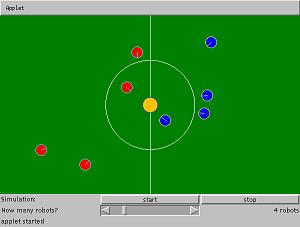
Explanations — altruism, lower-prices, no risk of vendor failure — abound. Here’s an idea to add to the mix. A computerised soccer game described in today’s New York Times offers a nice metaphor for Open Source’s dynamics and dynamism.

Working in a lab in Atlanta, Georgia, Tucker Balch has programmed computers to play a rudimentary game of soccer. The software is called TeamBots.


…the robots learn to play soccer by executing a random sequence of basic moves — running toward the ball, kicking it, moving behind the ball, blocking it. For every sequence, a computer program either rewards or punishes the robot with a digital signal telling it whether the sequence made sense and whether it should be repeated.


The “players” develop different models of behavior (and success)depending on whether they are rewarded individually or as a team.

Under the first scheme, a reward signal is sent only to robots that score a goal. As the match progresses, every team member ends up learning the same sequence of behaviors — going after the ball in a solo effort to score. As a result, the circles on the screen bunch around a single point — wherever the ball is — leaving the rest of the field open to attack.


Under the group-based reward scheme, all members in the learning team receive a reward whenever any of them scores a goal. After several learning loops, some of the robots ended up with behavioral sequences that made them good defenders. Others in the team evolved into forwards. “Group rewarding produced greater diversity,” Dr. Balch said, “and that made the team a winning combination.”

The New York Times notes that the soccerbots “behavior” may shed light on the behavior of individual humans; should everyone in a company get the same pay, wonders one commentator?

But it is also interesting to think about the soccerbots as stand-ins for larger economic players, i.e. companies.

In this recasting of the story, the Microsofts of the world all scramble after the ball, while the companies and individuals that build open source code avoid ball-hogging and collaborate. They disperse across the economic land-scape, specialize and benefit from the work of their differentiated peers.

And, like the soccerbots, “all members in the team receive a reward whenever any of them scores a goal” because OS products (and team members) become more powerful and pervasive. The leveragable network grows, which benefits all.

While we’re on the subject of metaphors about self-organizing systems, I enjoyed this review of Steven Johnson’s latest book Emergence: The Connected Lives of Ants, Brains, Cities, and Software.

The book explores the way disorganized individuals (like slime mold, sparrows, heart cells, and computer codelets) can, without premeditation or outside intervention, cohere into sentient-acting organizations. Under the right conditions, slime molds swarm, birds flock, heart cells beat in sync, and code can create winning soccer strategies.

By cohering, the individuals achieve mutual benefit, or what business school gurus call the Network Effect.

Which brings us back to the Open Source movement: can these individual corporate players evolve into a larger organization whose shape exceeds the abilities and expectations of any of the discreet players?

Yes and no. Economic competition will undoubtedly drive companies to evolve new forms of cooperation and interaction. But even when steered by human self-consciousness, evolution can take a LONG time.

Final note: Whenever possible, Pressflex uses and supports Open Source software including Linux, Apache, PHP, Zope, PostgreSQL, Webalyzer, and MySQL. And the software for soccerbots is essentially open source.

Henry Copeland from Paris, France

Latest tally: Drudge thrashes news competitors

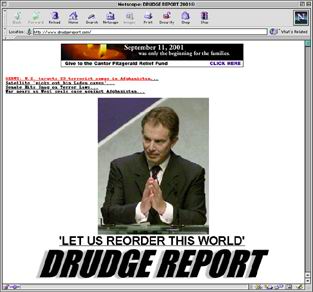
October 5, 2001 Want the latest news on the (apparently) pending attack on Afghanistan? NYTimes.com offers the carefully researched article titled “Powell Says U.S. Had Signs, but Not Clear Ones, of a Plot.” FT.com tells us “Nato given evidence of bin Laden’s involvement.” LeMonde.fr offers “La violence s’impose à Gaza.” Over at CNN.com, self-proclaimed server of 24-hour news, the headline “Taliban issues death threats” hasn’t changed for six hours.

Is this the latest news? Let’s visit www.drudgereport.com.

Clicking brings this news: “Satellite ‘picks out bin Laden caves’…” which links to an up-to-the-minute Times of London article with the details. Reload and… wait, here’s the Washington Times’ headline and link to “U.S. targets 23 terrorist camps in Afghanistan…”

Drudge “will find the link before you do,” says journalist Ken Layne, himself a fast and furious newshound.

It’s not just Layne who has noticed that Drudge is THE clearinghouse for the breaking news. According to the latest figures from Neilson/Netratings, DrudgeReport.com rang up 10,759,000 pages impressions for the week ending September 16.

That puts Drudge’s site ahead of the Washington Post, the New York Times, USA Today… and every US news site except Time Magazine and MSNBC. Click for the top twenty page-spinners.

Drudge inverts conventional web wisdom. Consider the odds against his success :

  1. Drudge’s site is a scoliotic skeleton of text. Haute couture for Drudge is pasting up a single snapshot.
  2. Up against news organizations with 100s of reporters and editors, the site is a one-man show; when Drudge sleeps, the site is static.
  3. When his competition’s traffic is churned out by visits to 100s of current pages and 1000s of archive pages, Drudge’s site is essentially ONE page.
  4. This page is expressly designed to send visitors away. Almost every word is a link to another site!

And this is what makes Drudge great. He knows what the public wants — news — and works tirelessly to deliver it. We can rely on him.

With galaxies of news and opinion available online, Drudge knows it’s better to build a telescope than another solar system.


When will someone log the echoes of September 11 documented in the local press?

Read a Cornwall paper’s obituary of a local boy who left home at 17, became an American, fought in Vietnam and died in the World Trade Center as head of Morgan Stanley’s security team. Or, for a lighter aside, there’s the Lincolnshire man who is selling his nightclub and “planning to fill his new warehouse at Stallingborough with a whole range of military supplies, including armoured cars, military-style hard hats, gas masks, survival suits and camouflage netting – in preparation for war.”

E-mail us if you know of more stories in this vein.

Adding nuances to “back to basics”

October 4, 2001 In the last blog, I argued that September 11 burst the seams of professional news sites & that these sites could learn from the contrasting success of blogs. Here are some other perspectives:

1) Simon Crane, with 15 years experience as a UK journalist and editor, agrees that site design too often exists “to serve the tastes of the designers rather than the users.” But the context and interactive features offered by publication web sites shouldn’t be purged in the rush to blog-like simplicity.

2) Corporate ego, not designers, may be to blame for traditional news sites’ over-engineering and brand-bloat. Photographer Reid Stott writes, “news has become obscured by heavy handed attempts at graphic branding that generate more clutter and confusion with poorly placed content.”

3) Book-design opinionado Dean Allen highlighted the “urgency and directness” of CNN’s September 11 site on his funny and insight-filled blog www.textism.com. “There’s such pure logic in the stripped design.” Don’t miss his link to MSN’s September 11 site and this comment: “You can picture some worthless little editor, sweating bullets, if I pull Elton John will I lose my job?”

4) Blogs are unreliable. Northcliffe’s Keith Perch acknowledges that “we are all guilty of overdesign” and cites his own experience of multiplying a site’s traffic by stripping out whizzy visuals. While agreeing that publishers can learn from blogs, he thinks the blog standard is too low to satisfy the average reader. “The truth is that many (most?) people do want their information edited – that’s what they pay for in newspapers. And they want it to be accurate and reliable.” Perch complains that many blogs “are inconsistent, links are broken, and they can take you inadvertently to places you don’t want to go.”

4) Blogs distill a reality too fragmented for a single organization to comprehend, says San Jose Mercury News’ columnist Dan Gilmore. Readers of weblogs on September 11 were “were witnessing — and in many cases were also part of — journalism’s future.” Bloggers know “that our readers, listeners and viewers collectively know more, vastly more, than we do,” says Dan.

6) The blog, as a diary of events, captures something missed by the computerized information-sorting schema used by most professional news sites. After rereading his own blog of September 11 long-time blogger Dave Winer noted “it’s good to have a record of the events as they happened.”

Let’s amplify this point. It’s GREAT to have a record of events “as they happened”… and great to be able to peruse the strata of one individual’s experience of those events.

The blog’s diary-like stacking of events is easy to take for granted… but this structure may be a key virtue.

Traditional publishers, scrambling daily to make room for cargo-loads of fresh-arriving news, shove their old product into a giant warehouses, from which it can be later extracted only through powerful search algorithms. But brute searching power can’t replicate the natural rhythm of scrolling back through the chronological record.

The blog’s chronological news sorting fits well with innate human story-telling (aka information-processing) habits.