Most magazines with sites ignore the Internet’s marketing power

September 15, 2001

Summary

Magazines are winning online but often do not know it, Pressflex’s survey of lifestyle magazine marketing professionals shows.

Nearly four out of five marketing executives at lifestyle magazines with web sites are missing out on their sites’ chief benefits – extensive contact with potential subscribers and advertisers and substantial print subscriptions generation, the survey found.

Two out of three lifestyle magazine web sites generate substantial print subscriptions, according to marketing managers for 95 publications in the UK, France and Hungary.

While some publishers have spent 100s of thousands of Euros on showcase sites, online subscription sales has no correlation with development or marketing expenditure, but does relate to the amount of content on the sites and the use of editorial features such as links, forums and e-mail newsletters.
Download this file in .pdf version

Table of Contents

Summary
Databites
Winning subscriptions with the web
Three types of executive
Country comparisons
Cannibalization… or seduction?
What brings sales: big budgets or small steps?
Marketing managers need to get involved
Conclusion
Methodology

Databites

  • 96% of lifestyle magazines with web sites receive print subscriptions via their web sites.
  • Magazines sell up to 30% of total new subscriptions online, or up to 25 new subscriptions per week.
  • An average 6% of marketing budgets are spent online (median = 4%), ranging from nothing to 80%.
  • Only 46% of web sites have any involvement from magazine marketing managers.
  • There is a high correlation between a marketing manager’s engagement in the website and the level of print subscription sales generated.
  • Just 17% percent of marketing managers are aware of the “free” market research available from the site – most popular articles, search engine terms used, search engine visits or size of traffic.

Winning subscriptions with the web

More than two thirds of marketing managers at 95 lifestyle magazines in the UK, France and Hungary said they sell a number of subscriptions and back issues through the web, but the majority of the respondents also reported that they have little or no role in shaping their web sites.

Chart 1: Do you receive print subscriptions via the web?
Do you receive print subscriptions via the web?

The survey, conducted by phone in August among 49 lifestyle magazine marketing managers, representing 95 magazines, also found that marketing managers receive little feedback from their web teams on what online readers actually care about on their site.

Three types of executive

The marketing managers at the magazines surveyed can be classified into three broad categories: “wired”, “waking up” and “indifferent”.

Wired (11%). These marketers pay close attention to the web site, are aware of traffic data and/or search terms used to access the site. They have also typically played a significant role in the creation of the web site. Not surprisingly, these magazines win the highest number of print subscriptions online.

Waking up (19%). These are marketing managers who are just coming to realize the importance of the web as a marketing tool. They are typically aware of some traffic data and use information from the web site as part of their market research. They are also trying to carve out some responsibility for themselves in overseeing the site.

Indifferent (70%). This group knows little about the web – or the advantages it offers. They have no information about the traffic of their magazine’s web sites, and have had very little – if any – role in the creation of the site.

Chart 2: What has been your role in the creation/management of the web site?
What has been your role in the creation/management of the web site?

Reflecting the lack of responsibility for the site of the typical marketing manager, at 81% of the magazines the marketing information collected as a by-product of the web sites goes completely unused. “I’m loath to receive data that I cannot use,” said the marketing manager at a major UK men’s lifestyle magazine. The marketing manager, who also said that his magazine has received subscriptions via the web, has not been involved with the creation and management of the web site.

Chart 3: Use of the web site to gather marketing information
Use of the web site to gather marketing information

Marketing tactics at the magazines surveyed include a mix of newsstand advertising, television, radio and billboard ads and cross promotion. But the abundance of contacts brought by the web is still overlooked, even at magazines that buy lists for direct mail purposes. In fact, not a single magazine marketing manager interviewed has mentioned the magazine’s web site among the magazine’s top market research tools, though 26% said that the information gathered from the site does pay some role in the market research efforts of the magazine.

Country comparisons

In the UK, which has the highest Internet penetration among markets surveyed, magazine marketers are more out of the development process than their peers in the less mature market of France and low-penetration Hungary. Just 13% of British marketing managers said they were heavily involved with the web site, with another 19% claiming a “bit” of involvement.

Though those who reported involvement have also said that they use the web site as part of their market research, three quarters did not know what the most popular sections of their magazine were online. None knew what search terms people used to get to their sites.

In France, three quarters of marketing managers were involved in the creation and/or management of their web sites, but even of these managers, two thirds did not know what search words readers used to access their sites. Only half of them knew what the most popular section was on their magazine site.

In Hungary, where 59% of managers in charge of marketing said they have been involved in the creation and management of the web sites, they were even less engaged with the sites: 86% said they had no idea what people are coming to look for, with the majority of respondents not even knowing whether their sites have been registered with and indexed by search engines. Almost two thirds (64%) of respondents did not know what were the most popular sections of their web sites.

Cannibalization… or seduction?

Contrary to the worry that online content cannibalizes print sales the survey indicated that more content online increases print subscriptions.

“At first we were surprised by the number of subscriptions we get online, but now we are used to getting half a dozen each week,” said the marketing manager of a small Hungarian magazine, which has decided to put most of its content online. “This is our only marketing expense.”

The survey found a direct correlation between the amount of information online and the number of print subscriptions generated through the web site.

Five types of strategies of content management emerged through the research:

  1. One quarter of the magazines surveyed have no real, updated content on the site, only a description of the magazine, some contact information and a subscription form.
  2. One third of respondents reported that their sites include headlines from the current issue of the magazine, as well as article teasers in some cases.
  3. A few magazines include only web exclusive content on the site.
  4. A few magazines combine headlines and article teasers from the print edition with web exclusive content.
  5. A few magazines put their entire print content online.

The research found that only sites with some form of real content (categories iii-v) excel in selling print subscriptions via the web.

However, whether that content comes directly from the print edition of the magazine or is online-only content was irrelevant in terms of the number of print subscriptions received. Since putting print content online carries little to no extra costs and has just as positive of a marketing effect as online-only content, it is the most economical way to using the site as a marketing tool.

Chart 4: Content vs. Print Subscriptions sold
Content vs. Print Subscriptions sold

Table 1: Content vs. Print Subscriptions sold

Content online All Some + Web only content Some Only web exclusive content None
Print Subscriptions
Significant 1 5 3    
Regular 1 3 13    
Occasional     5 1 1
Sporadic   2 5   7
None     2    

What brings sales: big budgets or small steps?

Winning subscriptions online does not correlate with substantial spending. However, a number of small, inexpensive strategies can have a significant impact on winning new readers.

Many of the magazines surveyed have special web teams who have created and are running the site. While in the UK every magazine contacted developed its web site in house, 53% of magazines in France and 64% in Hungary have outsourced development to third parties. None of the magazines surveyed used off-the-shelf products for the creation of their web sites, and only 4% have used an application service provider to create, host and maintain their web sites.

The means and the costs of site development have been irrelevant in the success of the site in generating subscriptions. None of the four French magazines who reported both professionally developed web sites and the use of web exclusive content noted significant subscriptions via the web. Indeed, two of them said they only get sporadic subscriptions.

The magazines where print subscriptions via the site had an important share of overall new subscriptions all have, beyond real content, a significant collection of links to other sites, and – in many cases – e-mail newsletters and reader forums. The correlation was especially significant in France and Hungary, where the less developed Internet market and less content competition in the native language mean that e-mail newsletters sent out by magazine publishers have fewer other marketing e-mails with which to compete.

Marketing managers need to get involved

Even at the largest magazines in the countries surveyed, full-time web teams consist of chiefly technical and editorial staff with no dedicated marketing involvement.

When the marketing manager of the print product does get involved with the web site, the expertise the marketing manager lent to the online operation paid off in new print subscriptions.

Chart 5: Marketing manager’s role vs. Subscriptions
Marketing manager's role vs. Subscriptions

Table 2: Marketing manager’s role vs. Subscriptions

  Decision maker Involved Bit involved Not involved
Significant 2 4 1 2
Regular 6 8 2 1
Occasional     3 2
Sporadic 1 1 2 10
None 1 1 1  

Many marketers with big plans and deep pockets admit that they mostly guess when it comes to promoting themselves using the Internet or backing up their e-marketing plans with data.

A large UK interior decorations magazine with a bespoke web site, for instance, plans to spend 80% of its marketing budget online, and is hoping to generate 15% of its new subscribers via the web as a result. The site has little print content and few links, and the marketing manager does not know what search terms people use to find the publication.

On the other hand, a small Hungarian lifestyle magazine with full print content and monthly e-mail updates generates 30% of its new subscribers via the web – with no funding allocated to marketing online. A French outdoor sports magazine also spends no money on e-marketing, but has a 100-strong link collection, full print content and four separate e-mail newsletters to people can subscribe – generating 10 new print subscriptions per week.

Conclusion

Although many magazine marketing professionals pay no attention to the opportunities offered by the Internet, content-rich web sites can provide substantial a marketing boost. Marketing executives who ignore the Internet leave money on the table, passing up free research and cheap subscriptions.

Methodology

For inclusion in the survey, lifestyle magazines were picked from media directories for the UK, France and Hungary. Interviews with marketing managers at magazines with web sites were conducted by telephone by Pressflex staff in the native language of the marketing managers. Of the 67 marketing managers contacted, 49, representing 95 magazines, participated in the survey.
Return to Top

Back to basics

September 20, 2001 Last Tuesday, I could not bear to turn on the television and watch the raw broadcasts. Instead, I compulsively riffled across the web trying to piece together how and why and what was happening.

Information was scarce, datapipes overwhelmed. I flipped from bbc.co.uk to boston.com to cnn.com to nytimes.com occassionally finding a live web page with another shard of information.

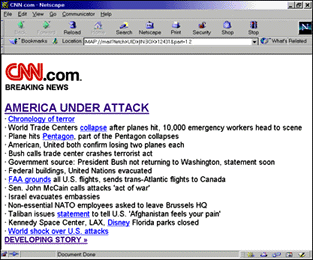
To speed thruput, CNN quickly stripped its site of photos and graphics. I took a screenshot. As you can see from the attached jpeg, CNN distilled its coverage to a series of unrelated sentences, some containing a link to another nugget of information. The New York Times also jettisoned superfluous imagery, including ads.

It wasn’t just our technological bandwidth that was overwhelmed. The Niagara Falls of information constantly blasted apart whatever vessels anyone held up to channel it. For news organizations, there was neither the time nor the strength for fancy graphics, editorial debates about explanatory boxes, pullquotes, or special logos.

The presentation we got was as close to being “unmediated” as media can get.

Thank God.

What we wanted was news, not media. Under the circumstances, we might have been insulted by anything too artful or pre-meditated. And, as we raced from URL to URL looking for a live server and another shard of news, who wanted to spare the time to decipher another web organization’s inbred graphical logic or arcane iconography?

Nine days after those horrible events, the online media is back “on.” Our news is once again finely sliced, polished and wedged into ornate jewel boxes.

The news is too often obscured by this craftsmanship.

The mind numbs quickly as it slogs through the web’s myriad styles and rubrics looking for facts and new developments. This might be OK if one site could deliver it all. But unfortunately, there is still too much going on for any site to comprehend and digest. To get a decent ration of news, hungry readers have to scramble through the tangle of competing styles and strategies.

In retrospect, that first CNN page served us well. The top item was the most important or newest piece of news. No item received more space than the rest, since no one dared predict how it all fit together.

It is worth noting that the CNN page looks like a blog. Formerly (and formally) known as “the weblog,” this style of web site is used increasingly by individuals to post short bursts of information with links to other sites or interesting articles.

Half diary, half reading list, the best blogs offer unadorned personal distillations of the Internet’s blooming, buzzing, mass of confusion.

Blogs are becoming the clearinghouse of choice for sophisticated readers online. Journalist-turned-technologist Nick Denton noted in today’s column in the Guardian that he now relies of blogs for news. Denton believes blogs have a unique knack for conveying “a wealth of information, a variety of opinion, and a subtlety of judgment.”

I would go one small step further. I think the graphical simplicity and uniformity of blogs helps readers get what they want. We can learn a lot from blogs.

Henry Copeland in Paris, France.

Blog 1: Servers need soul too

September 5, 2001 This page is where, after a long day at work, Pressflex kicks back, opens the windows, turns up the radio, invites friends over, whoops a little and listens a lot.

We wish to explore and catalog the potential of some of the technology we use. What makes a blog so engaging? What happens when search engines suck a newspaper’s morgue of past issues into the texture of daily life? How do you start a magazine online? Are site statistics useful to journalists?

More broadly, what new species of human experience may emerge from this bubbling global soup of electricity and enzymes?

Because we love the publishing business, we will often focus on the ever-expanding implications for publishers of the 50-years-young computer revolution. Call us old-fashioned. Call us ink-stained wretches. We don’t mind — we are convinced that paper and ink will be integral to the next age. (If the year is 2014 and you just found this page via a Google search, please write to tell us how we turned out.)

Much of this page will be devoted to directing your attention to interesting articles or commentary.

So too today. Here’s Christopher Locke, gonzo Internaut, deriding the way companies try to communicate online:

“You know if you walked in to a party that you’ve been invited to by some friend, and you went and you started acting like a marketer, I mean they’d throw you out. And that’s kind of what’s going on here. You’ve got all these parties going on and here come these clueless guys in suits with their canned spiel and we’re going, why don’t you tune into to what’s going on at this party, why don’t you meet some new people and shut up for a minute? You know, get a feel for who your neighbors are and maybe you’ll make some new friends. But, man if you just keep up that sales pitch, nobody wants to hear you.”

Read the full interview at www.publish.com. You should also see Locke’s own Rageboy.com, and Nick Denton’s Blogorama, where I originally found the link to Locke’s diatribe.

The Internet engages people best when it challenges, entertains, informs and alerts. There are a lot of funny or brilliant or articulate people online. Their discourse is often enthusiastic, spontaneous, lively… and sometimes goofy or illinformed.

To compete in this ecosystem, a publication’s web site must feel like a human expression rather than a corporate excretion. Right now, too many sites feel like the latter.

To close this first blog, it might be fun to splice in a little Net history — click for a spotty version of the 1984 Super Bowl advertisement for the Apple Macintosh , the ad that portrayed a massive TV-clad face preaching to huddled drones:

“For today, we celebrate the first glorious anniversary of the Information Purification Directives. We have created, for the first time in all history, a garden of pure ideology. Where each worker may bloom secure from the pests of contradictory and confusing truths. Our Unification of Thought is more powerful a weapon than any fleet or army on earth. We are one people. With one will. One resolve. One cause. Our enemies shall talk themselves to death. And we will bury them with their own confusion. We shall prevail!”

As the speach ends, a dashing young woman hurls a sledgehammer… the face explodes… the drones are free.

Do you agree?

Managing well means measuring well.

Too many web sites were launched with only the vaguest of missions –“beat the competition” … “don’t embarrass us” … “don’t spend too much” … “do something with a database.”

So it is no surprise that the majority of sites are little-used money-losers.

It’s hard to run a race when you don’t know where the finish line lies, who you are competing against, and what the distance is.

Page views and unique users have become two common measures, but unfortunately, say little about a site’s health.

Can portals averaging 50 million page-views a month really be called a success if the cost is £50 million a year, barge-loads of management distraction and angry shareholders? Hardly.

Pressflex provides powerful tools for evaluating your web strategy’s efficiency and probable long-term success. Step back to see if your strategy measures up… your shareholders will thank you.

Is your site stagnating? Call Pressflex

Serving both Europe’s largest and smallest publishers, Pressflex expertise includes:

Technology Optimization
In the rush to get online, many site developers ignored design principles and publishing opportunities. Their sites achieve only 5% to 50% of potential traffic. Careful, low-cost revision can dramatically boost revenue.

Re-integration

Striving to reduce headcount, many publishers are axing their Internet teams and rolling web sites back into their print operations. Drawing on the experience of other publishers, Pressflex can help plan this transition and make sure your work-flow remains rational.

Priority review
Internet teams are easily distracted by low-impact tasks. Pressflex reviews Internet team members’ responsibilities, pinpoints activities that are ineffective or counterproductive and recommends productive alternatives. Sometimes other people see things about you that you can’t — you don’t cut your own hair, do you? If you would like our help, please contact us.

The Pressflex Engine is:

Cost-effective

Measured by cost per million page views, Pressflex sites are the industry’s most cost-effective. Our commitment to excellence and emphasis on service is reflected in our prices: rather than charge a large upfront fee, Pressflex bills a smaller fee annually. The fee covers Pressflex’s data center, bandwidth, site registration, system administration, software usage, and training.

Rational

While traditional web-design firms build sites one-at-a-time, Pressflex serves publishers from a single, constantly evolving data-center and software platform. The client’s site is turnkey; clients need no technology, software or technical staff, only quality content, a web browser and the desire to succeed.

Powerful

Pressflex sites include features not yet used by some big daily newspapers and national magazines:

  • publication of full content, instantly sorted by section, journalist, or geographic area
  • categories and subcategories
  • password-protected content
  • rotating banner and button ads
  • automated e-mail updates to subscribers
  • comprehensive searchable archives
  • an automated online directory of partners and affiliate sites
  • reader polls
  • headline export
  • an events calendar
  • easily revised print subscription forms
  • photos and graphics

Simple

Publishing one issue takes just one hour of an entry-level staffer’s time. By outsourcing site creation and maintenance to Pressflex, clients eliminate the need for all web hardware, software, webmasters, database administrators or designers.

Easy to manage

Traditional web sites are engineered by members of secretive guilds: the “sysadmin,” the “web master,” and the “page designer.” Do you have the time and stamina to manage these artisans? Pressflex speaks your language — using words like accountability, accuracy, and return-on-investment, rather than “CGI,” “DHTML” or “ODBC compliant.”

Traffic-boosting

E-mail updates and searchable archives guarantee site traffic will grow year after year. Standardized navigation ensures visitor comfort. And search-engine-friendly HTML and automated metatags for every article maximize placement in search engines.

Reliable

Pressflex understands that data is your most valuable asset. Our secure firewalls keep your data safe from prying eyes and tampering fingers. We use constant, real-time backups to protect it. And Pressflex’s team of system engineers has one job: To make sure your site is available 525,600 minutes a year.

Efficient

We specialize in serving publishers and excel in helping clients succeed online. Pressflex consultants know what news excites Internauts, which headline is effective for an e-mail newsletter, what publishing rhythm boosts traffic, what features best prompt revisits. Pressflex staffers save clients many hours finding, understanding and registering at search engines and directories that are crucial to building a site’s traffic. And Pressflex engineers administer each site’s hardware and software, fine-tuning constantly for performance and security.

Pressflex seminars fuel Internet success.

Fast-evolving and complex, the Internet gives smart publishers a huge edge over sluggish competitors. But without proper know-how, investments in fancy web sites are often squandered.

With expertise gained serving publications across Europe, Pressflex can help maximize the Internet’s benefit to your staff and partners.
Our seminars include:
Site Kick-off
This half-day presentation introduces your staff to the new web site’s features. Don’t depend on trickledown — receptionists need to promote online archives, deliverymen want to know about online subscription forms, and ad reps need to understand the partner directory.
General Internet Literacy
This one-day course covers everything staffers need to know about the Internet (but are afraid to ask.) The course explains principles and teaches skills. E-mail, search engines, web browsers, directories, chat, forums, security, privacy, cookies and more are covered.
The Internet for Advertising Representatives
The morning introduces Internet concepts, while the afternoon covers Internet advertising terminology and selling tactics, and analyzes opportunities in the local market. This course is ideally scheduled three to six months after site launch.
The Internet for Advertisers
This afternoon session introduces a publication’s top advertisers to the Internet and its benefits. Ideally, this course is scheduled in tandem with training for ad representatives.
Executive Introduction to the Internet
This intensive one-day course covers Internet concepts and trends relevant to the newspaper executive, with an emphasis on strategies for online growth and benchmarking success.
For more information about Pressflex seminars, please click here.

From Budapest to Chapel Hill


Budapest, Hungary
Most of Pressflex’s technical and consulting team work in Budapest, not far from the cafe that inspired the “six degrees” concept. Our software is built by graduates of the university that produced Rubik’s cube, the atomic bomb, goulash, the carburetor, the four-wheel sprung carriage and the ball point pen. Pressflex’s polyglot consultants cajole publishers across Europe.


Chapel Hill, NC
Our colleagues in the US enjoy the humid splendor of the Research Triangle, a technology center in North Carolina. They work on: AdBiblio, an advertising service for book publishers; Racery, a host of virtual races for companies and charities; and WhichWorksBest, an online toolkit for single person (n-of-1) experiments. Plenty of start-ups and smart people make the Triangle a cutting-edge infopolis.

Tel: +1 919 307-9404‬

Against long odds, print publishers thrive online

A print publisher’s site is the first stop when the average Internaut logs on each morning. Unlike the other one billion-odd web pages it competes against, this site has

  • a thriving brand,
  • the nitty-gritty information people crave,
  • deep commercial roots,
  • an unbeatable print advertising platform
  • a proven community of readers and advertisers.

Pressflex knows how to make your publication thrive online.
Pressflex quickly and efficiently boosts a client’s

  • advertising revenues
  • subscriptions
  • reader and advertiser satisfaction

while leveraging the client staff’s commercial and editorial strengths.